Showing posts with label vegan. Show all posts

Monday, September 26, 2016

Life, it's bigger

Yeah so I feel like the presidential debates might literally determine whether humankind exists in 50 years or not, so watching them has been a bit of a stressor for me.


I made this tomato salad during the first set of presidential debates, and I have to say that it was overall a calming experience.  My high school health teacher might have called it a source of eustress.  Now, I'm not all vegan vegan vegan these days, but I have to say that this combination of crunchy almonds and nutty-sweet sunflower sprouts worked together to give the whole dish the character of a BLT, without any meat or dairy.  Next time, a few sprinkles of smoked salt and brown sugar might be welcome.

--

Tomato salad with sprouts and fried almonds
Serves 3-4

2-3 lbs tomatoes, ideally a mix of some heirloom and some cherry
a bunch of scallions, sliced and separated into whites and greens
1/2 cup (4 oz) almonds
4 oz sprouts (e.g., sunflower, bean, clover), washed and dried
olive oil
kosher salt
black pepper

Slice the tomatoes into rough chunks, about 3/4" - 1" in size.  Halve any cherry tomatoes.  Toss them with a few large pinches of salt and let sit for 20-30 minutes while you prepare the rest of the dish.

Add 3-4 tbsp olive oil to a pan and set it over the lowest heat setting possible on your stove.  Add the sliced whites of the scallions, with a few pinches of salt.  Cook over low heat, shaking occasionally, until slightly browned, around 10 minutes.  Pour the scallion whites and their oil into a small jar.

Add another 1-2 tbsp olive oil to the same pan.  Roughly chop the almonds and add them to the pan, still over low heat.  Cook, shaking every 2-3 minutes. until the almonds are lightly browned, about 5-10 minutes.  Season with kosher salt and black pepper, then pour into a small bowl.

Pour any reserved juices from the tomatoes into the same jar as the scallions and their oil, then add 4-5 chunks of tomato.  Using an immersion blender, puree until a thick dressing is created.

Toss the sprouts together with the marinated tomatoes, almonds, scallion greens, and the dressing.  Serve with a few pieces of toast rubbed with garlic.

Saturday, December 5, 2015

Since U bean gone

Alright, so it's Thanksgiving, your 36-pound turkey is out of the oven and you've placed it directly into the refrigerator for leftovers, as I suggested.  Still, you're in need of something to cut through the intolerable richness of leek bread pudding, mashed potatoes mounted with garlic butter, and cauliflower gratin.  It needs to be green.  And, honestly, neither endive with hot bacon dressing nor brussels sprouts fried in olive oil are going to hack it.


Somewhere along the line, America developed this idea that you need to stew green beans into silky submission on Thanksgiving, then top them with something deep-fried to restore their crunch.  No!  Crisp, snappy beans are just fine, and contrast perfectly with everything else in your typical spread.  In the past, I've taken blanched beans and glazed them quickly in butter, then added some dill or mint to brighten them up. This year, I decided to go even lighter, and improvised a new, Chinese-inflected take.  In the interest of time (and stove space), I tossed the cooked beans in a caramelized fennel vinaigrette, then scattered some roasted persimmons among them.  To serve, I just warmed the casserole through, then topped it with roasted sichuan peppercorns.  Crunchy, fresh, and packing just enough peppery heat to wake you up in the middle of dinner--these beans will be back next year. 

--

Green bean casserole with fennel and persimmons
Serves 8+ as a side

This is truly a casserole for celebrating Thanksgiving in California, perhaps the only time and place where one can credibly serve green beans and persimmons together.  If you're making it elsewhere, or at the height of summer, you could substitute under-ripe peaches for the persimmons.  I've also thought of this dish as playing a great supporting role at to a vegan Thanksgiving--also an institution unique to California.

3 pounds green beans, stemmed
5 medium fuyu persimmons, about 1-1.5 pounds
2 medium shallots, about 4 oz
2 bulbs fennel with stalks, about 1 pound
1 tbsp soy sauce
1 tbsp zhenjiang vinegar (or balsamic vinegar)
1 tbsp sugar
3 tbsp sichuan peppercorn (optional)
Chili powder
Kosher salt
Olive oil

Blanch green beans:  Bring a pot of salted water to a rolling boil, and prepare an ice bath while the water is heating.  Blanch the green beans for 2-3 minutes, until they are a vibrant green and just crisp.  Drain the green beans and plunge immediately into the ice bath until cool.  Remove the green beans in the ice bath and set aside to dry.

Caramelize fennel:  Remove the fronds from each fennel bulb and discard.  Separate the stalks from the bulbs and slice the stalks thinly.  Separate the tough outer ribs from each fennel bulb.   Retain the inner part of the bulb for marinated fennel, below.  Slice the outer ribs and stems thinly.  Halve each shallot, remove the skin, and slice thinly.  Add the sliced fennel and shallots to a small saucepan along with 4 tbsp olive oil and a pinch of salt.  Cook over low heat, covered, until lightly browned and caramelized, about 30-40 minutes.  Add the soy sauce and vinegar and cook for another 5 minutes to concentrate the flavor, then remove from the heat.

Meanwhile, marinate reserved fennel:  Remove the tough inner core from each retained fennel bulb and discard.  Slice the bulbs as thinly as possible, then toss with kosher salt to taste.  Allow to marinate for 20-30 minutes while preparing the rest of the dish.

And roast persimmons:  Slice each persimmon into 8 pieces, then toss the slices with 2 tbsp olive oil, a few pinches of salt, and chili powder to taste.  Roast in an oven preheated to 400 °F until tender but not falling apart, about 15-20 minutes.

Assemble casserole:  Mix together the blanched green beans, caramelized fennel, marinated fennel, and roasted persimmons in a large bowl, then turn the entire contents of the bowl into a casserole dish.  In a small skillet over medium heat, toast the sichuan peppercorns until fragrant, about 1-2 minutes, then grind them in a mortar and pestle and sprinkle over the casserole.  The casserole will keep for 1-2 days covered in the fridge.  To serve, heat just barely through--about 10 minutes in a 350 °F oven.

Monday, June 9, 2014

It ain't easy

Every time Jeff and I have anyone over to our house, I say to myself:  This is the one.  This party is going to be logistically easy and stress-free, and I'm just going to lay back and enjoy it.  I will not wake up at 8 AM for this party.  I don't need to bake fresh chocolate chip cookies halfway through this party; I don't need to stock the pantry with five kinds of brown liquor for the hot toddies; I don't need to shop at four separate grocery stores.  I will pare this party down to its barest essentials.  I will slice things off this party until it's just a fun-loving skeleton.


Fast forward to noon on Memorial Day this year and Jeff is slowly smoking two dozen chicken thighs on our little inherited Weber grill, and I've been up for five hours cutting up fruit for the vanilla-nectarine sangria.  You know, it was easier than other recent events at our house have been.  Unlike Labor Day, I didn't make twelve square feet of corn bread.  Unlike Christmas, I didn't have three sheets of compost cookies hanging out in the freezer overnight.  And unlike Thanksgiving--well, unlike Thanksgiving.


This gathering was really almost impromptu, conceived over a pig roast just a week prior, so we kept the guest list down to a mere 20 people.  Of course, because my job is scaling up chemical processes, throwing a small-scale barbecue just seemed like an invitation to make things that don't scale up well, like grilled focaccia with morels and green garlic.  Grilling bread is totally my new thing--at least, until summer hits San Francisco and it's too cold to grill.  I know what you're thinking:  no, it doesn't fall through the grate.  And yes, it is great.


Among the too-many things we made, though, this potato salad was definitely the lifesaver.  A huge cold dish that's easy to prepare and ready to go directly from the fridge, as a party dish it's hard to think of anything better.  While I make do make quite a three-bean salad, it's this potato salad that's going to be making a repeat appearance at every future barbecue from now until the next potato blight.

Inspired by Heidi's incredibly complicated salt and vinegar potatoes, which we made on the grill just a week prior and inexplicably decided to forgo at this barbecue, this salad hits just the right notes of sharp tang and cooling herbaceousness to cut through any heavy barbecue dish that you might make.  It's just about perfect as a side dish, and hearty enough to fill up any vegans that stop by too.

--

Vinegary potato salad
serves 15-20 as a side

5 pounds yukon gold potatoes
white vinegar (up to 1 quart)
kosher salt
white sugar
1 bunch (5-6) scallions
2 tbsp mustard seeds (yellow or brown; I used a 50:50 mix)
1/2 cup olive oil
1 bunch dill, picked or chopped into small fronds

Slice the potatoes lengthwise into 1/4 - 1/2-inch thick slices.  Place in a large pot and cover with a mixture of half white vinegar and half water (depending on the shape of your pot and potatoes, you may need quite a bit of vinegar).  Add a few very heavy pinches of salt to the water.  Bring the water to a simmer and cook the potatoes in barely simmering water until just tender.  Be careful not to let the water boil too heavily, or the potatoes could disintegrate.  Drain the potatoes in a colander and set them aside.

Meanwhile, slice the scallions very fine and toss with a mix of kosher salt (1 tbsp) and sugar (1 tsp) to taste.  Set aside and let marinate.

Toast the mustard seeds in a skillet with no oil over high heat until they just begin to pop (about 10-20 seconds), then remove the skillet from the heat and add the olive oil to the skillet.  Set aside and let infuse.

Once the potatoes have cooled completely, finish making the salad.  If the scallions have exuded any liquid, mix it in with the mustard-seed-infused olive oil.  Toss the scallions in with the potatoes, then pour the olive oil over the salad and toss to combine.  Top with dill to taste, then toss again.

Sunday, October 21, 2012

That's why I chose kale

Over exemplary croissants at Knead Patisserie on Saturday morning, I found out from Jeff that the party we were attending that evening was, in fact, a potluck.  I'm always impressed by people who throw potlucks, because I'm the kind of dinner party host that brandishes a citrus zester at his guests to drive them out of the out of the kitchen and over to the coffee table (where there's a bottle of sparkling wine and a spread of cocktail olives and salted melon).  To let other people into my apartment bearing food that I've never seen before, some of which might even need some space in my oven, or use a plate that I wasn't planning to get dirty--just the thought of it makes me want to go lay down.

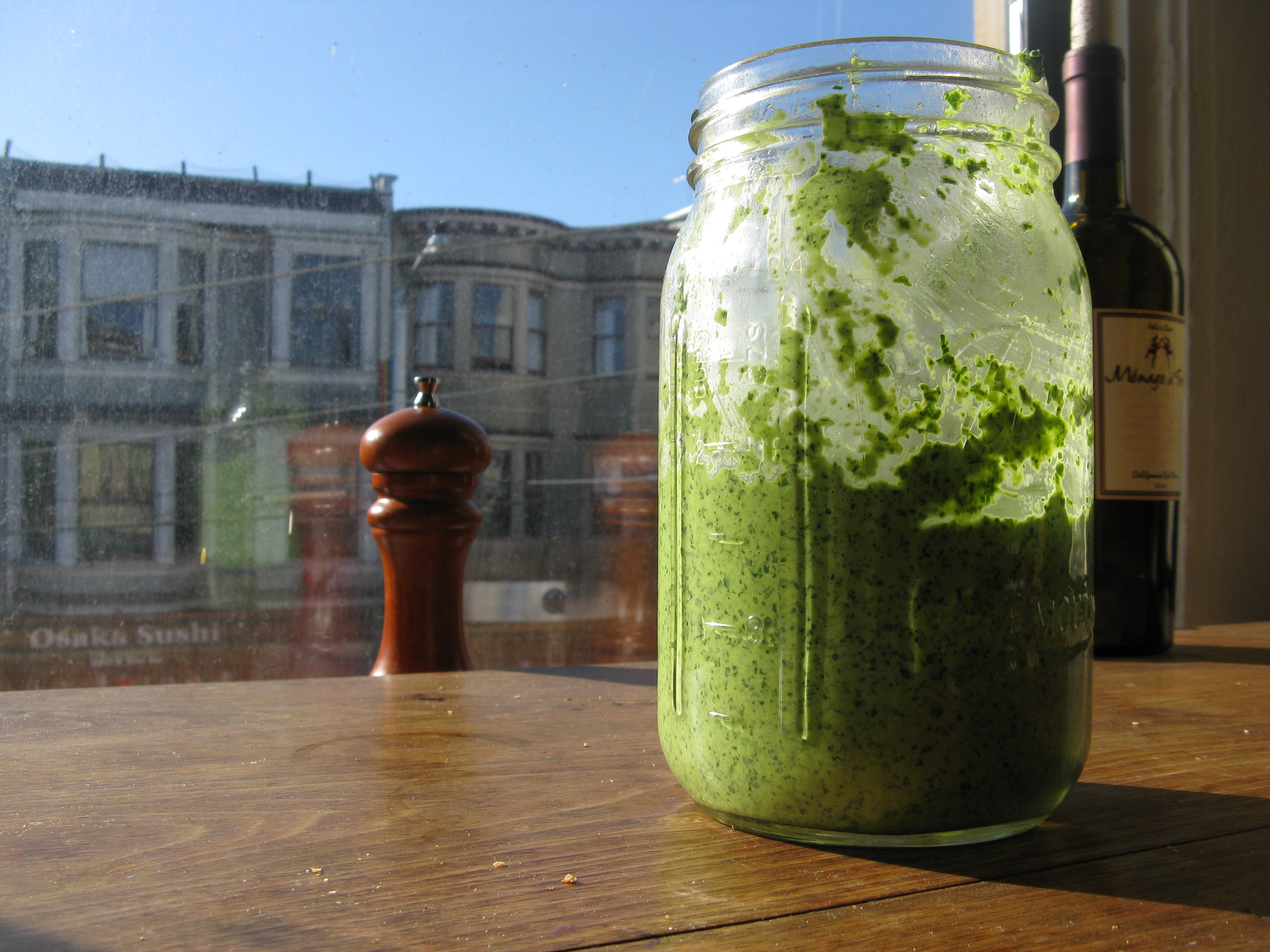
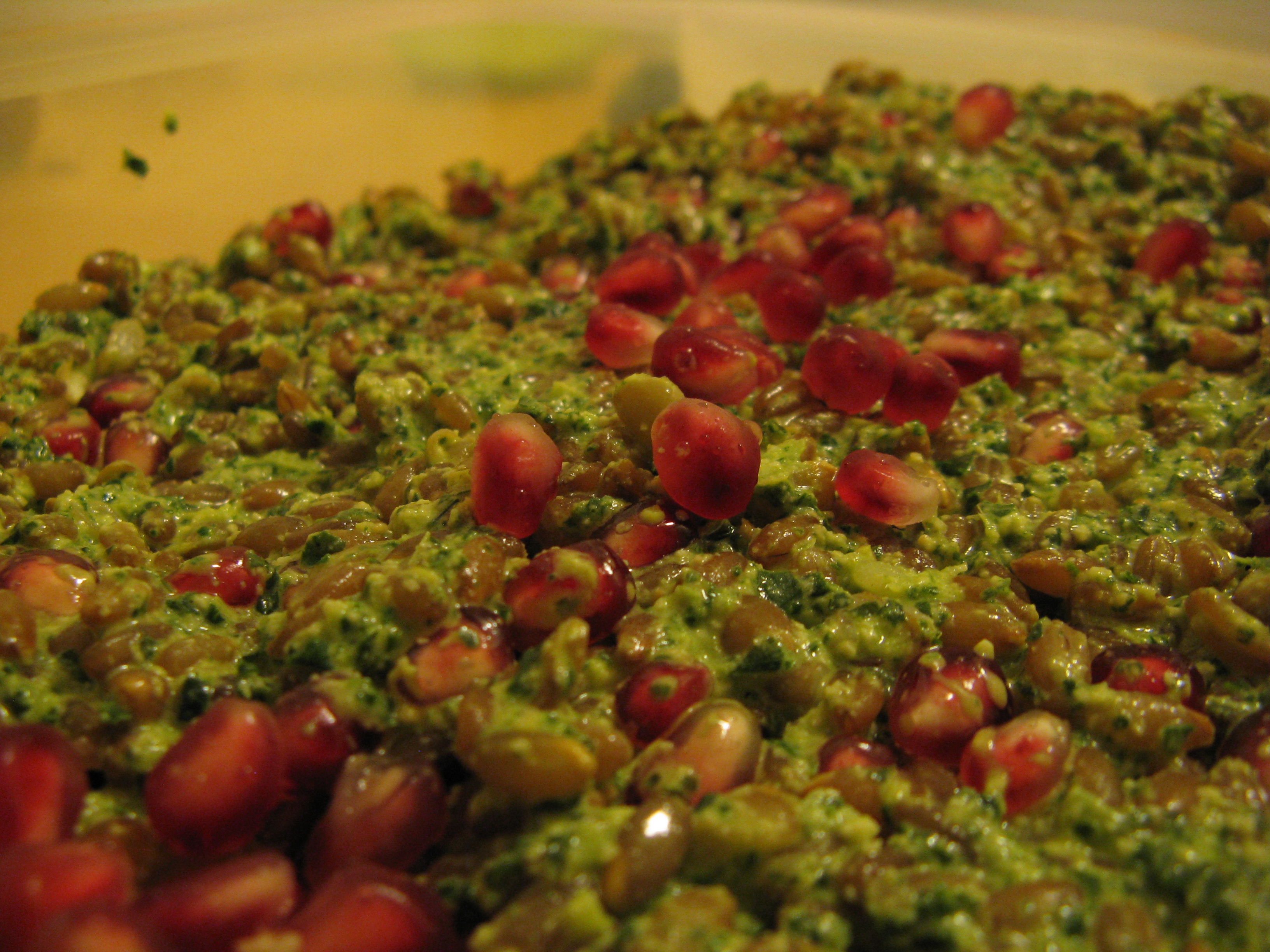
But all the potlucks I attend seem to turn out well and make all of their guests happy, so maybe the rest of society is onto something here.  At this one, the hosts put together a delicious Persian-inspired spread, supplemented by a tortilla espaƱola and a paella courtesy of their Spanish roommate, as well as dozens of desserts and cured meats brought by friends from all over the city.  I'd been gifted a lovely bunch of Serendipity Farms tuscan kale by my friend Chelsea, art therapist and part-time pumpkin plucker, so I decided to make a autumn grain salad featuring a kale pesto, which turned into a dip when I inadvertently set it down next to a bowl full of kettle chips.  See, this is what happens at potlucks.  I can't control it!

I've never thought about dipping potato chips into rye berries before, but the starch-on-starch collision worked just great, a chew and a crunch in every bite, bound together by a kale pesto that was surprisingly bright in both color and flavor.  The pesto would be equally tasty clinging to tubular pasta, mixed into green eggs with ham, or spooned around a braised meat.  It's a brand-new recipe that's definitely going into my regular rotation, and one I never would have made if not for a bunch of greens and a last-minute potluck invitation.  You must change your life.

--

Rye berry salad with kale pesto
Serves 3-4

1 1/2 cups rye berries
scant 1 cup raw cashews
3 cloves of garlic / a shallot
a bunch of kale
a pomegranate
salt
olive oil

First, cook the rye berries.  Add about 2 tbsp olive oil to a pot and toss the rye berries in it.  Heat the pan over medium heat, stirring frequently, just until the rye berries are warm and toasty-fragrant but not scorched.  Add 4 cups of water and a few large pinches of salt to the pot, bring to a boil, cover, and simmer until the rye berries are chewy and cooked through, 60 - 90 min.  If there's any excess water in the pan after the berries have cooked, pour it off.

While the berries are cooking, seed the pomegranate.  Fill a large mixing bowl with water.  Cut the pomegranate in half and remove the seeds from the inner membranes and pith while holding it under water.  This will prevent the juice from splashing all over you, like you just performed a pomegranate autopsy.  The seeds will sink to the bottom, while the pith and membranes will float on top of the water.  Skim off anything floating on top of the water and discard, then drain the seeds.

Toast the cashews in the oven at 400 F.  Spread them out in a pan in a single layer, toast for 6 minutes, shake them, and then toast until they're fragrant and lightly brown, another 6-8 minutes.

Cut the kale leaves into rough chunks, discarding the tough lower stems.  Add the chunks to a large bowl full of water, swish around with your hands to remove any dirt, and then lift the kale out of the water into a strainer.  You don't need to dry it completely.

Remove the garlic skins and cut the cloves into medium-sized chunks.  Cook over medium heat in a pan with 2 - 3 tablespoons of olive oil just until the garlic is softened and golden but not at all toasted, 3 - 5 minutes.  Add the kale and continue cooking over medium heat, stirring gently as the kale near the bottom of the pan begins to wilt and lose volume.  As soon as all of the kale has softened and turned bright green, remove the pan from the heat--you don't want to overcook it.

Using a blender, blend together the kale, garlic, and cashews with a few big pinches of salt and an additional 1/4 cup olive oil to make a bright green pesto.  If the pesto looks a little thick, add some water, or a splash of olive oil.  Taste it to make sure that it's salty enough.

When ready to serve, mix together the rye berries and pesto, turn to coat, then fold in the pomegranate seeds.  The salad can be served warm or cold--or, apparently, as a dip.

Wednesday, October 10, 2012

Don't call my name, gazpacho

Jeff gets a farm box (actually it's more like a farm bag) every few weeks and the great thing about it is that it's an opt-in system instead of an opt-out system.  I like fresh produce as much as the next San Francisco resident (i.e., I would vote YES on a ballot initiative allowing me to marry it), but I also like to have some choice, and I can't always work my way through an entire head of cabbage in seven days' time.  So it's nice to be able to look into a fridge full of condiments and tortillas on a Tuesday afternoon and say--this is the week, let's do it, let's get some fruits.

And I do get inspiration when something unexpected, but lovely shows up.  Had I been at my friendly neighborhood produce market last week, the fog in the air probably would have convinced me to buy potatoes and kale, rather than the fruits of late summer.  But the farm bag came full of last-of-the-season heirloom tomatoes and red peppers, and it's hard not to get excited about peppers from Mariquita Farms.  They're really a revelation, a serious crunch giving way to the thinnest skin and the most concentrated bright burst of pepper flavor I can imagine.  They made me realize that Chairman Kaga probably accomplished the legendary pepper-chomping opening scene of Iron Chef without any trick photography or sound editing.

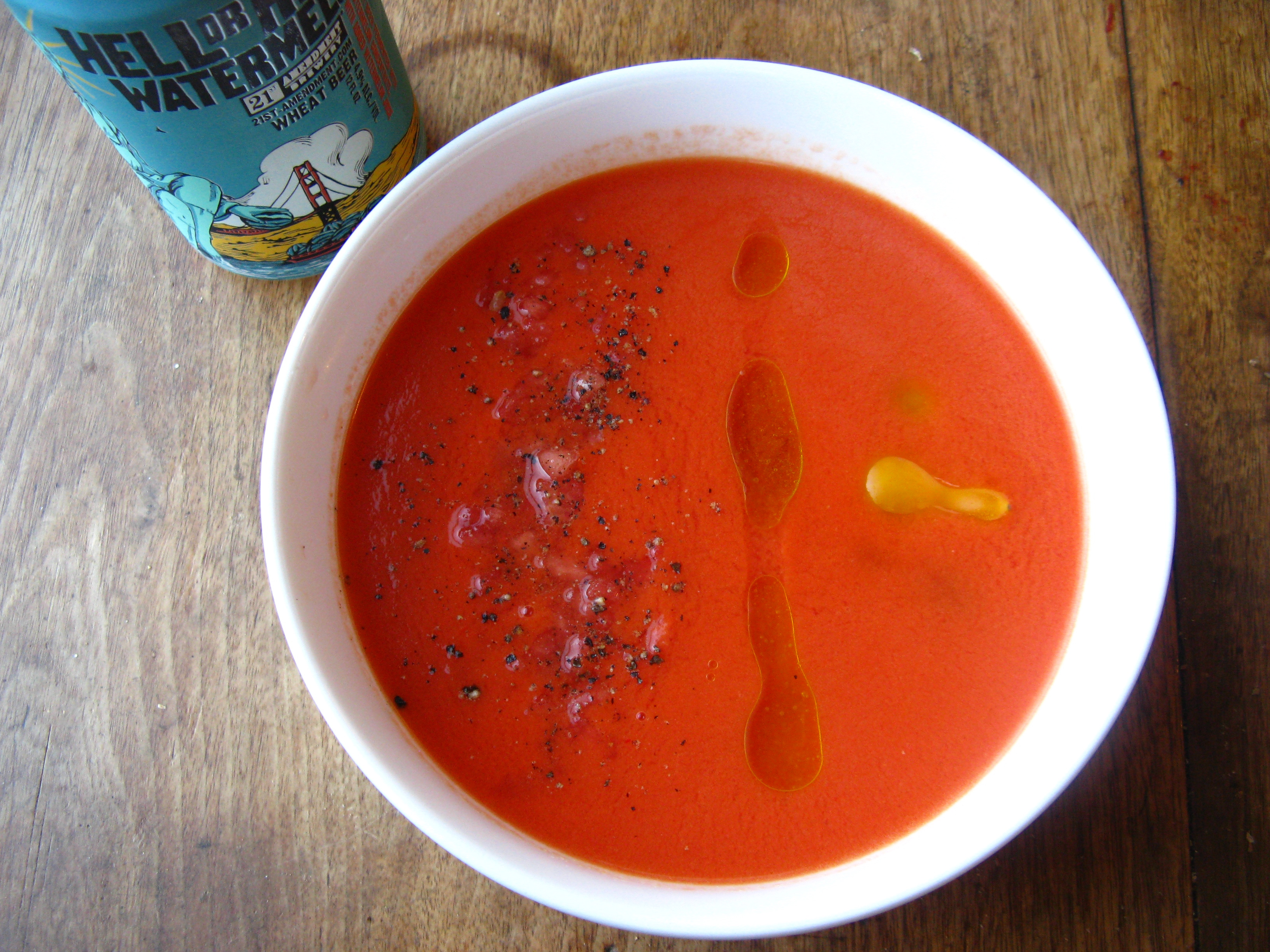
I had picked up a nice, hollow-sounding watermelon earlier in the week, and I've been kicking the idea of a watermelon/pepper gazpacho in my head for a while, so I decided that now was the time to make it happen.  It worked out a differently than I had envisioned (entasted?) but possibly better, with those tangy peppers dominating the flavor, but tamed by the sweet background of watermelon, enriched with a helping of diced watermelon that I added to the finished soup.  I've made gazpacho before, and though this one called previous versions to mind, it was decidedly a fruit soup.  It worked.  See you next year, watermelon gazpacho.

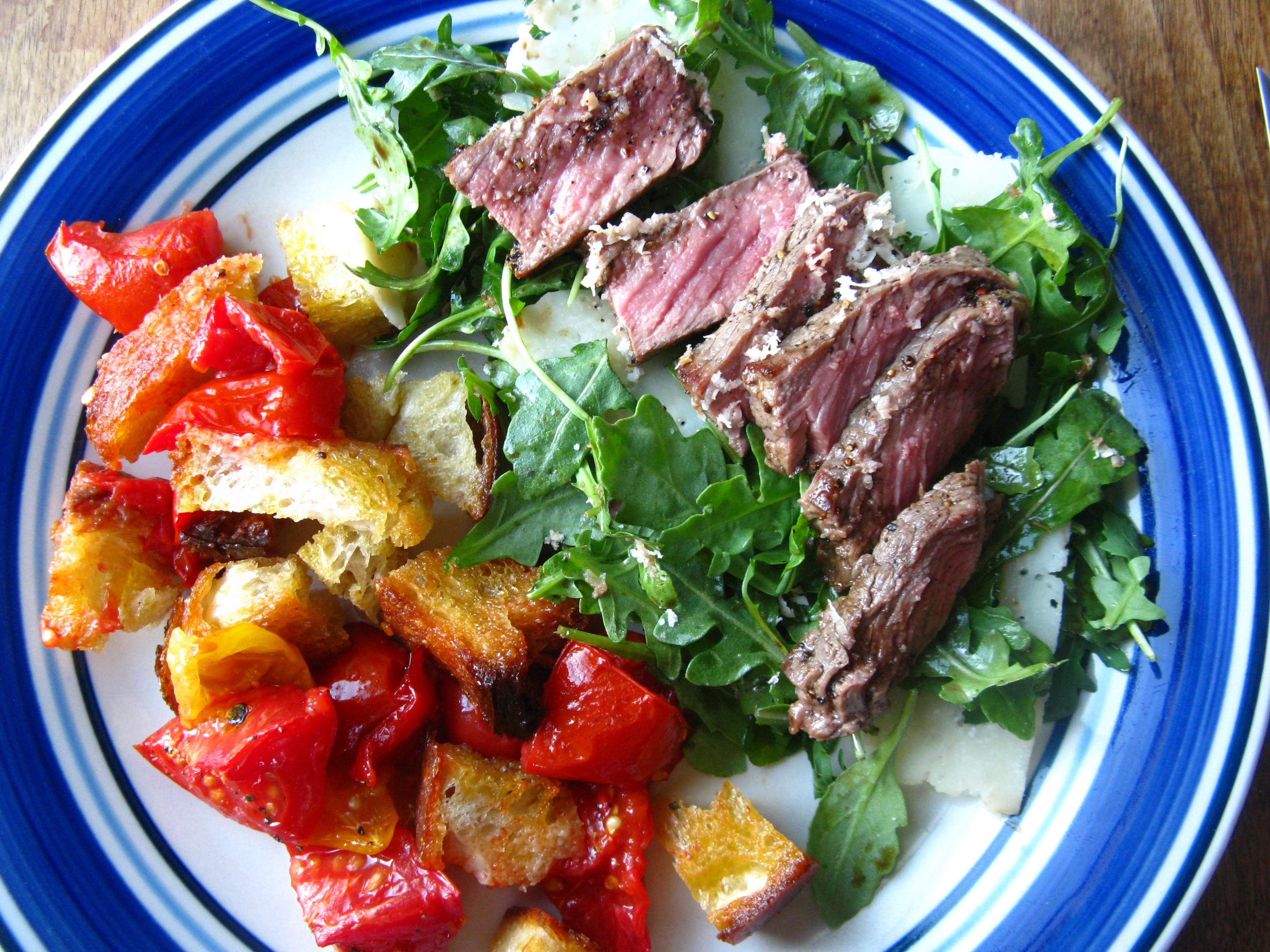
Some of the tomatoes later found themselves roasted in a panzanella accompanying a steak salad, a dinner so simple that it barely needs a recipe.  In a 400-degree oven, roast some tomatoes with garlic and salt, and toast some bread cubes until crunchy.  Mix those together.  Sear a half-pound strip steak on each side.  Let it rest while you toss some arugula into a bowl and shave some romano cheese.  Slice the strip steak thin and place it on the arugula, dress with olive oil and balsamic vinegar, top with cheese and shave over some horseradish.  Jeff and I washed it down with a cabernet franc, and then we biked to the San Francisco Symphony, and then we met Chloe Sevigny.  A good night!  And we have a farm bag to thank for it.

--

Watermelon gazpacho
serves 4-6

2 lbs watermelon, plus more for garnish
3/4 lb red pepper, cut up
2-3 medium red tomatoes, cored and cut up
a small yellow onion, sliced
a hot pepper, seeded and sliced
1/4 cup (or more) olive oil
kosher salt
sherry vinegar
black pepper
a few cherry tomatoes, for garnish

Peel and cut up 2 lbs of watermelon, and add it to a bowl with the red pepper, red tomatoes, onion, and hot pepper (if you'd like your gazpacho a little spicy, add in just a few seeds from the hot pepper).  Add water just until the fruits and vegetables are mostly submerged (1-2 cups), then add a few big pinches of kosher salt and stir.  Allow the mixture to sit at room temperature for 1-2 hours.

After the fruits and vegetables have marinated, transfer them to a food processor and blend for a few minutes until the mixture is as smooth as possible.  Depending on the size of your food processor, you may need to do this in two batches.  Pass the soup through a fine-mesh sieve, pushing on the solids to extract as much juice as possible.  Anything that's left behind should be pretty much flavorless.  You can also use a food mill to accomplish all of these steps simultaneously.

Once the soup has been strained, blend in 1/4 cup olive oil.  Taste it, and season with sherry vinegar, and salt as necessary.  If the soup needs more body, blend in additional olive oil.  Chill the soup to allow the flavors to mellow and combine, at least 3 hours, or up to a few days.

When ready to serve, halve some cherry tomatoes and dice a small piece of watermelon into very small cubes.  Remove the soup from the fridge and blend it again to combine the oil and juices.  Add a few cherry tomatoes and some diced watermelon to each serving bowl.  Pour soup over the fruits, then garnish with additional watermelon and tomatoes, olive oil, and black pepper.

Wednesday, October 3, 2012

Guess what? I'm still hot.

Maybe I've been living in San Francisco too long that I think it's the only city in the world that has an Indian Summer; on the contrary, Wikipedia tells me that the term's probably-racist etymology can be traced back centuries before our fair city even had English-speaking residents. So let's not say Indian Summer anymore. This being San Francisco, I'm surprised that nobody has yet lobbied to change its official designation, maybe to something snappy like the the only week in San Francisco that is actually warm.

That's right, ditch your light sweater, pull that dusty fan out of the coat closet, and meet me at Trader Joe's to pick up some sparkling raspberry lemonade for our picnic on Ocean Beach, because it's truly, unqualifiedly warm this week.  If other cities do have unexpected warm spells, surely none is as dramatic as a autumn heat wave in San Francisco. For a city where "a nice summer day" translates to "the fog broke from 1 PM to 5 PM and there was a concert on Speedway Meadow," coming home from work in 82-degree heat in the tenth month of the year is like wandering through someone else's muggy California dream.

And I don't really like it. Look, I know Californians are generally wusses when it comes to weather, but I very deliberately moved here for grad school so that I would never have to experience a temperature below 52 or above 73 degrees Fahrenheit (good choice!). Also, I've been getting ready for Fogtober, so last week I ditched all the late-summer tomatoes and melons from my shelves to make room for squash and potatoes, pears and rosemary.  I want to bake, I want to braise, I want to roast a chicken every single night.  What am I supposed to do when the air in my apartment is hanging so thick and still that I won't even heat up the oven for five minutes to make toast in the morning?

I have choir rehearsal in an air-conditioned hall in Berkeley twice a week, and on Monday evening when I got home from that, Jeff had yet another wonderful meal waiting for me--white bean succotash with tomatoes and smoked eggplant spread.  Over dinner and a pint of cold, cold cider, he let me know that there was some pie crust chilling out in the fridge, in case I had any particular ambitions for it.  Apparently his original plan was to make a tomato pie, but this seemed like less and less of a winning idea as the thermometer continued to climb into the later hours of the evening. I'm glad he reconsidered; I think if I had come home to a pie baking in a 400-degree oven, I would have fainted.

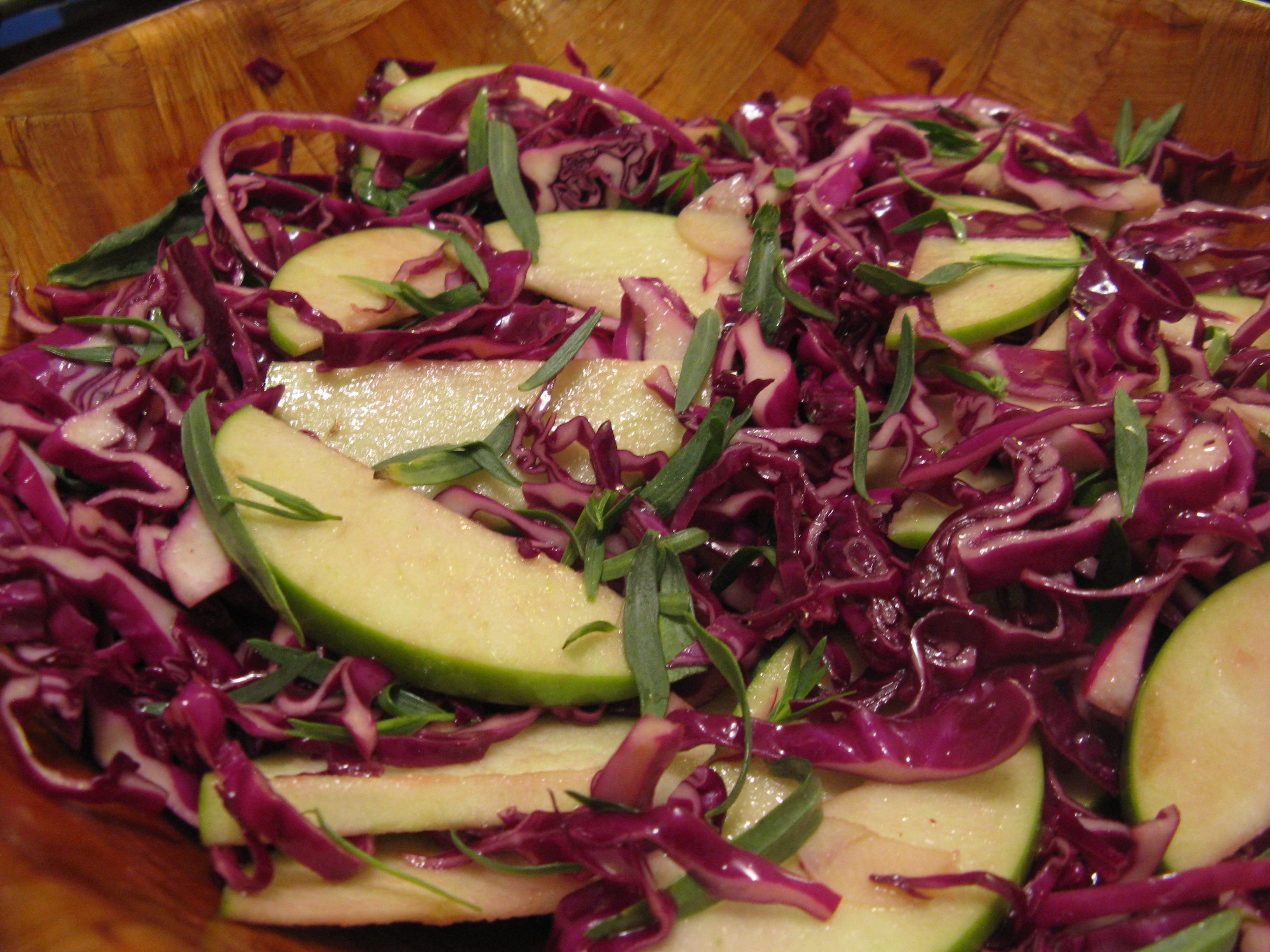
I understand--it's hard to solve the simultaneous equations that lead you to a dinner that maximizes taste while minimizing the temperature of your apartment, especially when heat coaxes so many new flavors out of ingredients.  Yesterday evening it was my turn to make dinner, and my first instinct was just to make salad, which almost seems like cheating.  In The Art of Cooking with Vegetables, Alain Passard describes this mixture of cabbage, apples, garlic, and tarragon as "lip-smacking."  I'm not sure if he means delicious, or tart, or crispy, or that the salad will actually kiss you, or some other untranslatable French idiom--all I know is that it was a very effective savory combination of a few ingredients that I might not have thought about putting together.

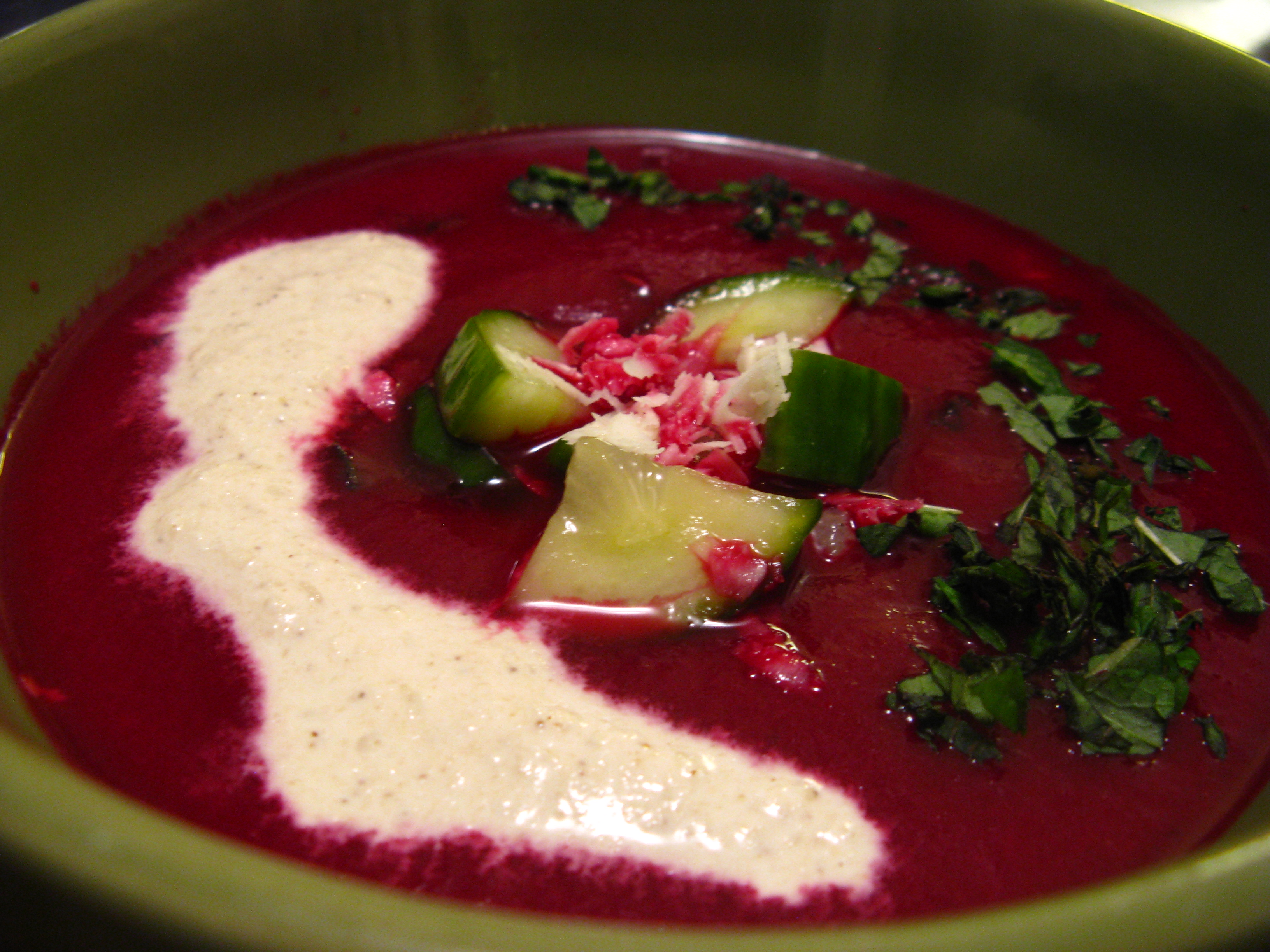
But I decided I needed to do one better than a lip-smacking salad--I needed something refreshing, and as close to frozen as possible.  Looking at the array of fall vegetables I had collected over the weekend, and not really wanting to step outside, I decided on a cold beet soup, even though it did require turning on the stove to boil beets for an hour.  After a few minutes of work with my hand blender, I threw in a quick-pickle of some cucumbers and garnished it with a little mint (cooling) and fresh tahini (creamy).  I even chilled the bowls.  It worked!  So sweet and so cold.  I'd make it again.  I'd even serve it warm.  Just not until Fogvember.

--

Ice-cold beet soup with cucumber pickles
Serves 4-6

6 red beets, about 2 lb
a red onion
an english cucumber
1 cup white vinegar
1 cup sugar
2 bay leaves
12 black peppercorns
1/4 cup (or more) olive oil
1/4 cup tahini
fresh horseradish root
a few sprigs of fresh mint
kosher salt
sherry vinegar

Quarter the red onion and cut it into thin slices.  Place the onion slices in a large pot with the beets.  Add water to cover the vegetables, along with a few big pinches of salt.  Bring to a boil, then turn the heat down to low and simmer until the beets are completely tender when pierced with a knife, at least 30 minutes but maybe up to 60 minutes or even longer.

While the vegetables are simmering, make the pickles.  Cut the cucumber into rough chunks, toss with two tablespoons of salt, and add to a colander.  Let the cucumber sit for 30 minutes.  Meanwhile, bring the white vinegar to a boil in a small pot along with the sugar and 1 cup of water.  When it boils, stir to dissolve the sugar completely, remove from the heat, and add the peppercorns and bay leaves.  When 30 minutes have passed, rinse off the cucumber pieces in cold running water and transfer them to a large jar or bowl.  Pour the sugared vinegar over them and store them in the refrigerator.

When the beets are completely tender, remove them from the pot and run cold water over them until the outsides have cooled off a bit and you can handle them easily.  Using gloves or a paper towel, rub the skins off the beets and discard.  Cut one of the beets into medium-size cubes and set aside.  Take the remaining beets and cut each one into a few pieces.  Using a hand blender or food processor, puree these beets, along with all of the stewed onions and a little of the beet cooking liquid, until completely smooth.  Add more of the cooking liquid until you get a soupy texture, keeping in mind that the soup will be thicker when served cold.  Taste, and adjust the seasoning with olive oil, sherry vinegar, and salt.

Keep the pickles, the beet soup, and the beet cubes in the fridge until chilled completely, at least 3 hours, or up to a few days.

When you're ready to serve, add the tahini to a small bowl and stir in a little water to thin it out, until it's a thick, yet pourable consistency.  Add a few beet cubes and pickles to each serving bowl and pour the soup over them.  Garnish with the tahini, finely minced mint leaves, and fresh shaved horseradish.

Monday, February 6, 2012

How I make ... oatmeal

When I was taking Russian 3, after we had finished the unit on hygiene and the imperfective aspect we were tasked with preparing a short oral presentation describing the actions we take every day to get ready in the morning. I looked up the word for oatmeal (Š¾Š²ŃŃŠ½ŠŗŠ°, if memory serves me correctly) and organized my essay around that. Every morning I put oatmeal on the stove. Then, while the oatmeal cooks, I take a shower, wash my hair, brush my teeth, use the toilet, get dressed--in that order--and come back to make sure the oatmeal is cooked completely. Then, after mixing in some сироп and nuts, I eat it. I eat it with a spoon. Every morning. I have to say, it was one of the most successful talks I ever gave in Russian class, perhaps second only to the presentation I gave we learned different terms for family members. I pretended to be Sarah Palin and described my myriad progeny, prefacing the talk by noting, "You may think it's strange that I am speaking Russian to you right now... but, конечно, I can see Russia from my house."

It was true that I was eating oatmeal just about every morning for breakfast when I was in Russian 3. It wasn't true that I was brushing my teeth before eating it--gross. Even though I tend to lean toward a two-egg omelet or a quick socca for breakfast these days, I think oatmeal will always hold a special place in my heart as my favorite breakfast food. Maybe it's not a weekday thing--it's a slow food, the kind of meal you need to toss on the stove first thing when you wake up before you've had your coffee and then shovel down after you're already late for your bus. But if you take a little time, sit down on the weekend and make some oatmeal, spike it with some honey or a poached egg... oh my stars! Oat my stars.

INGREDIENTS

3 parts steel-cut oats
1 part millet
1 part quinoa
1/2 part pearl barley
1/2 part brown rice
1/4 part amaranth
1/4 part wheat bran
kosher salt

METHOD

Mix the grains together and store in a large jar. Make sure they're evenly distributed.

One serving of oatmeal is about half a cup of oatmeal mix. When you're ready to make oatmeal, pour your desired quantity of oatmeal mix into a pot and cook over low heat for a minute or two, just to toast the grains. Add several generous pinches of salt and four cups of water for each cup of oatmeal mix. Bring to a full boil, then turn the heat to low, cover, and cook for 30-40 minutes. At that point, taste a spoonful to make sure all the grains are cooked through. If they are, remove the lid and cook over medium heat, stirring occasionally, until the oatmeal reaches your desired consistency.

VARIATIONS

The seven grains above make up my preferred oatmeal blend, but more often than not I'll just use whatever I have hanging around, haphazardly grabbing a few random bags of grain out of the pantry and tossing them into a pot one-by-one. Feel free to experiment.

Here are a few failed experiments on my part: 1) too much amaranth can give you a grassy flavor, which can be unpleasant unless you're a cow; 2) buckwheat turns really sludgy and gross; 3) wheat berries will never soften by the time your oatmeal is ready. I'm about to have these findings published in a peer-reviewed oatmeal journal.

If you want to go gluten-free, you can ditch the barley and the wheat bran, and make sure that the oats you're using weren't processed in a facility that also processes wheat.

If you're adding a fat like brown butter or olive oil, it doesn't hurt to toast the oatmeal mix for a few seconds in that and then add the water. Be careful to do this over very low heat and for for just a few seconds--tiny grains like amaranth can burn very quickly when you're toasting them in fat.

NOTES

I like red quinoa better than golden quinoa, but it's gotten really expensive, as chronicled in this article, which is kind of a downer. Black quinoa can be kind of sandy and I do not dig it--like, who was eating my oatmeal at the beach? Is that a hermit crab?

Any kind of rice is fine, including super fancy jade or black rice, but try to pick one that cooks in 30 minutes or less so it's not too chewy when the oats are done. Now that I'm not using red quinoa anymore, I dig red rice for its nuttiness and color contrast.

Oatmeal keeps surprisingly well in the fridge--make a larger batch earlier in the week, and then later in the week you can heat up a portion by stirring into an extra half-cup of boiling water and cooking for 5 minutes or so. The texture is a little less exciting than fresh oatmeal, but it gets the job done.

Some people like cooking their oatmeal in milk or cream--I think it's a very Irish thing to do--but I actually like the contrast of cold milk separate from the warm chewy grains. But don't listen to anything I say; you might end up in grad school.

IDEAS

PBAB -- Once the oatmeal is cooked through, add a few tablespoons of peanut butter and stir until smooth. You may need to add a little warm water to thin things out afterward. Pour the oatmeal into a bowl and garnish with tangy apple butter, maybe a little milk too.

Elvis -- Add peanut butter as above, then garnish with sliced banana, chopped toasted peanuts or walnuts, milk, honey, and granola. What really makes this for me is cooking the oatmeal extra long so it's nice and chewy, then pouring cold milk over it. Lovely.

Fat Elvis -- Peanut butter, then garnish with sliced banana, crisp bacon (duh), and honey. Sans oatmeal, plus oat bread, this is also my favorite sandwich on Earth.

Good Morning, Campers -- Extra-virgin olive oil, maple syrup, and salt. Last year, I spilled half a pot of this on a rock on the way to Clouds Rest in Yosemite. Warning--this oatmeal is so delicious that after you make it for the first time, you will be asked to make it on all subsequent camping trips.

Ultimate Oatmeal -- Maple syrup, miso, and tahini. I like this because it marries three flavors from different continents into one crazy good savory oatmeal. Mix the miso and tahini with a little hot water before adding them to the mix, otherwise they'll clump up, and nobody wants to hit a big chunk of miso paste in the middle of breakfast.

Sunday Oatmeal -- Caramelize some onions with salt and curry powder, then serve the oatmeal with a poached egg and caramelized onions. Wonderful.

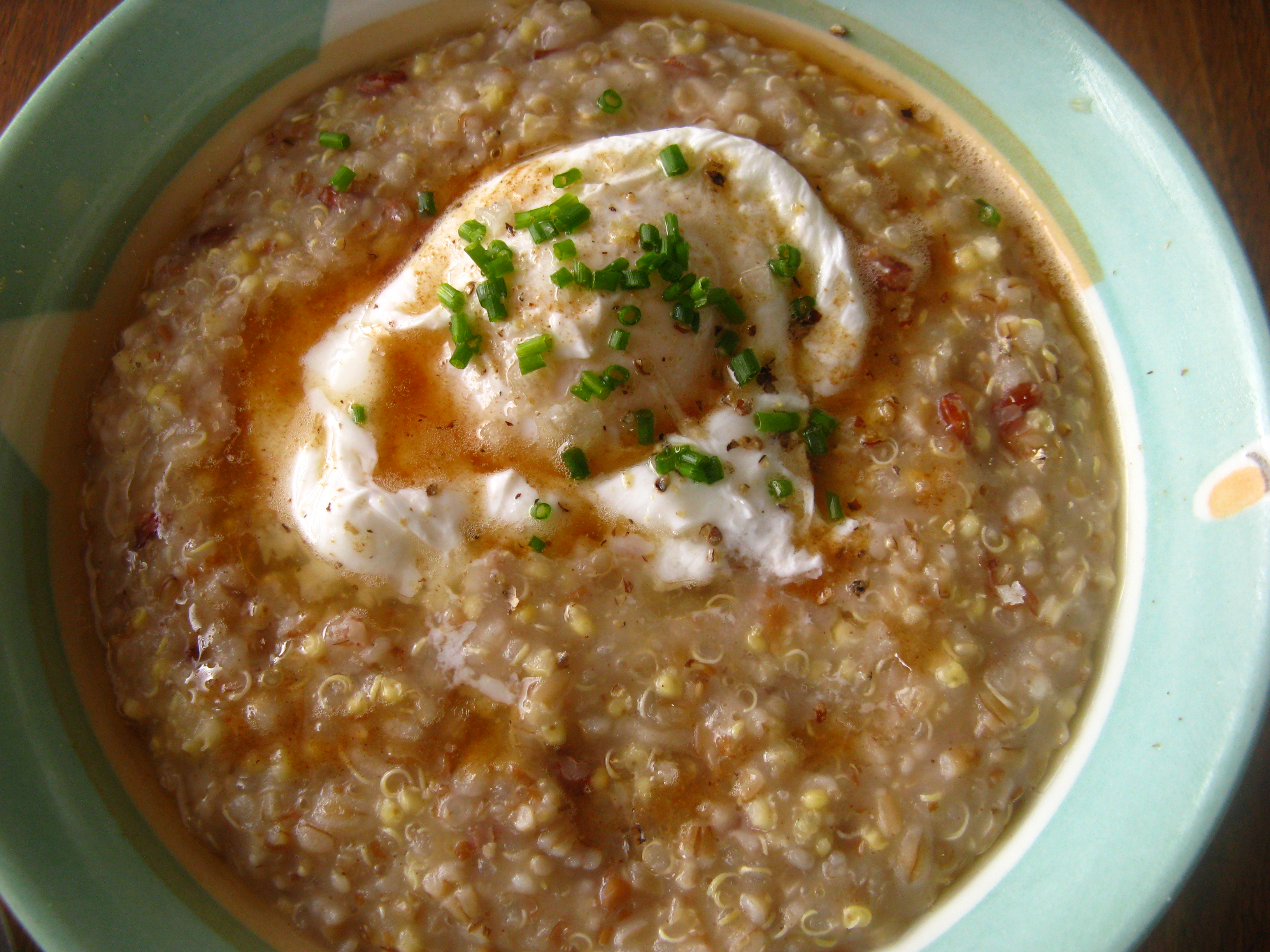
Arpeggio -- Brown a tablespoon (maybe two) of butter per person in the pot that you're going to use to cook the oatmeal. Pour half of this brown butter off into a small bowl. Toast the grains in the brown butter for a few seconds, then add water, salt, and a light drizzle of maple syrup. While the oatmeal is cooking, poach one egg per person and keep them in a bowl of cold water. When the oatmeal is ready, reheat your poached eggs in simmering water for 15 seconds. Top each bowl of oatmeal with a poached egg, a drizzle of brown butter, finely minced chives, fancy salt, and white pepper. Stunning. See photograph above.

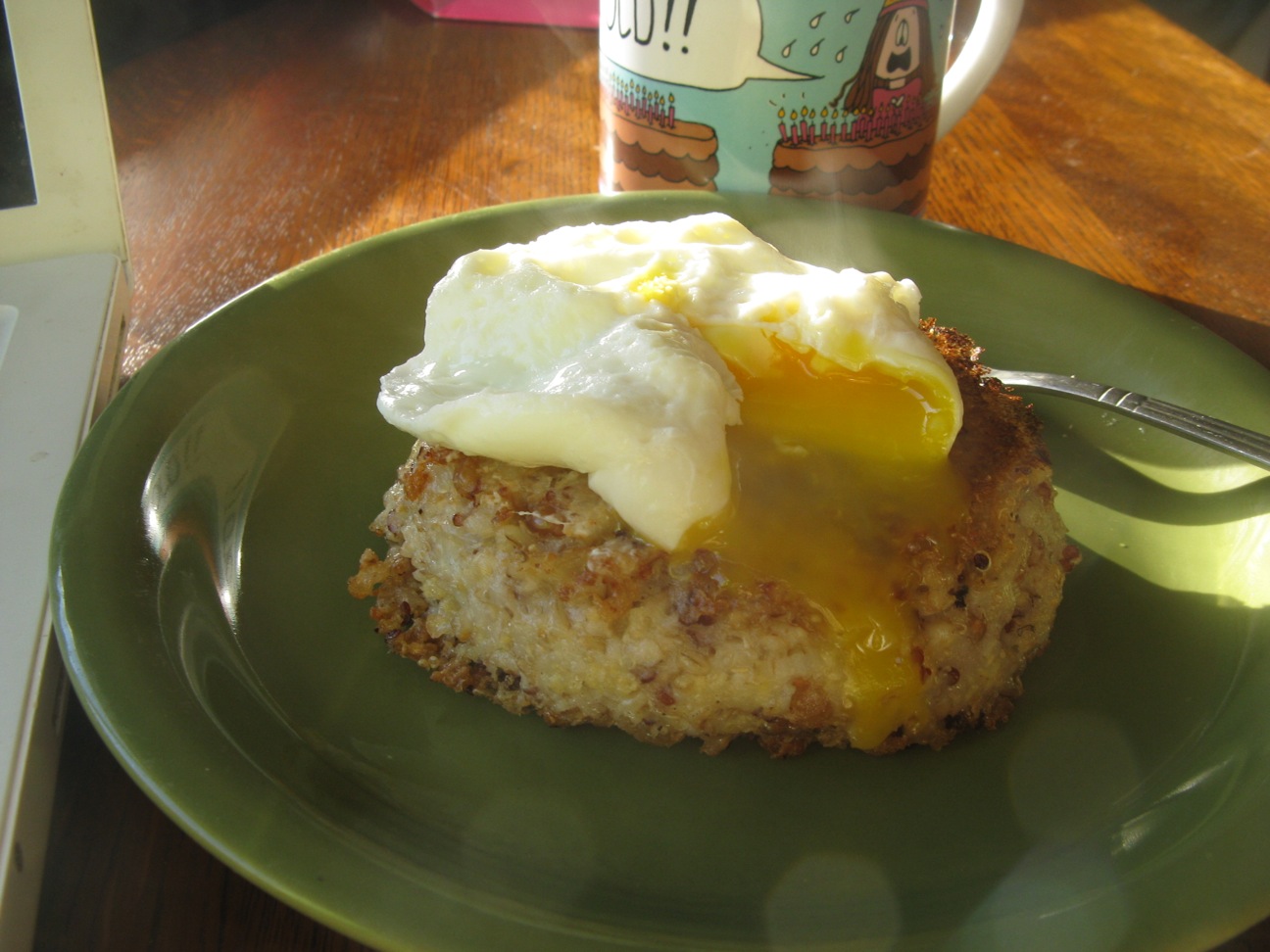
FRIED OATMEAL -- Make some extra oatmeal. Right before you add any fatty elements like cream, milk, peanut butter, or tahini, take a serving of oatmeal and spread it out in a shallow dish at a thickness of 1/2 inch (crispy) - 1 inch (custardy). Let the oatmeal cool to room temperature, and then cool it, covered, in the fridge overnight. When you're ready to have your mind blown, take the cooled oatmeal and fry it in a cast iron skillet over medium heat with a bit of butter (clarified butter is even better, because it won't start smoking). Add a little more butter, flip, and place the skillet into a 350 ĀŗF oven. Cook for 5 or 6 minutes, or until warmed through and crispy on the second side. Move to a plate, 9then top with salt, pepper, and a poached egg. Tears. Streaming.

I've always thought that oatmeal or fried oatmeal would be a really good bed on which to rest some lamb braised in tomato sauce. Or, if you're a vegan, some cauliflower roasted with turmeric. Either way, it's something I need to try at my next dinner party.

Sunday, November 20, 2011

More soup, more soup

So two weeks ago angel-headed hipster Sufjan Stevens came to town to perform at this little shindig just four doors down from our apartment. Using the internet, I discovered that a couple of my friends from around the Bay Area were going to be in attendance, so I offered to host a casual dinner for all of them before we headed the show. What to cook? At first, I was thinking about making a few dishes based on Sufjan Stevens songs, such as Casimir Pulaski Dayboat Scallops, The Age of Adzuki Beans, or Chicago Deep-Dish Pizza (Which toppings do you use? "All things go." What if you mess up? "I made a lot of mistakes.").
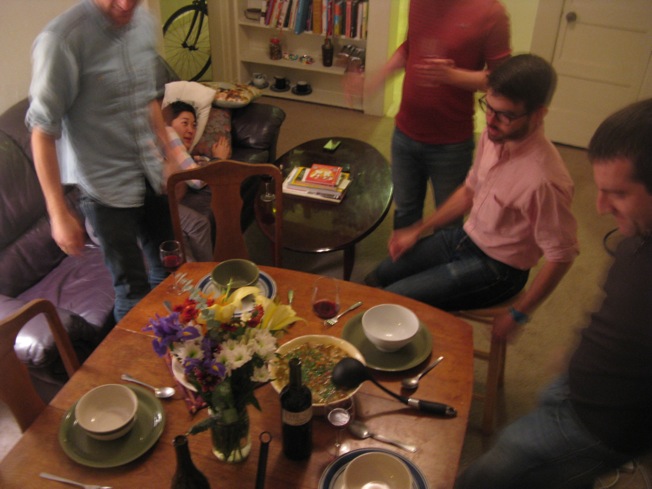
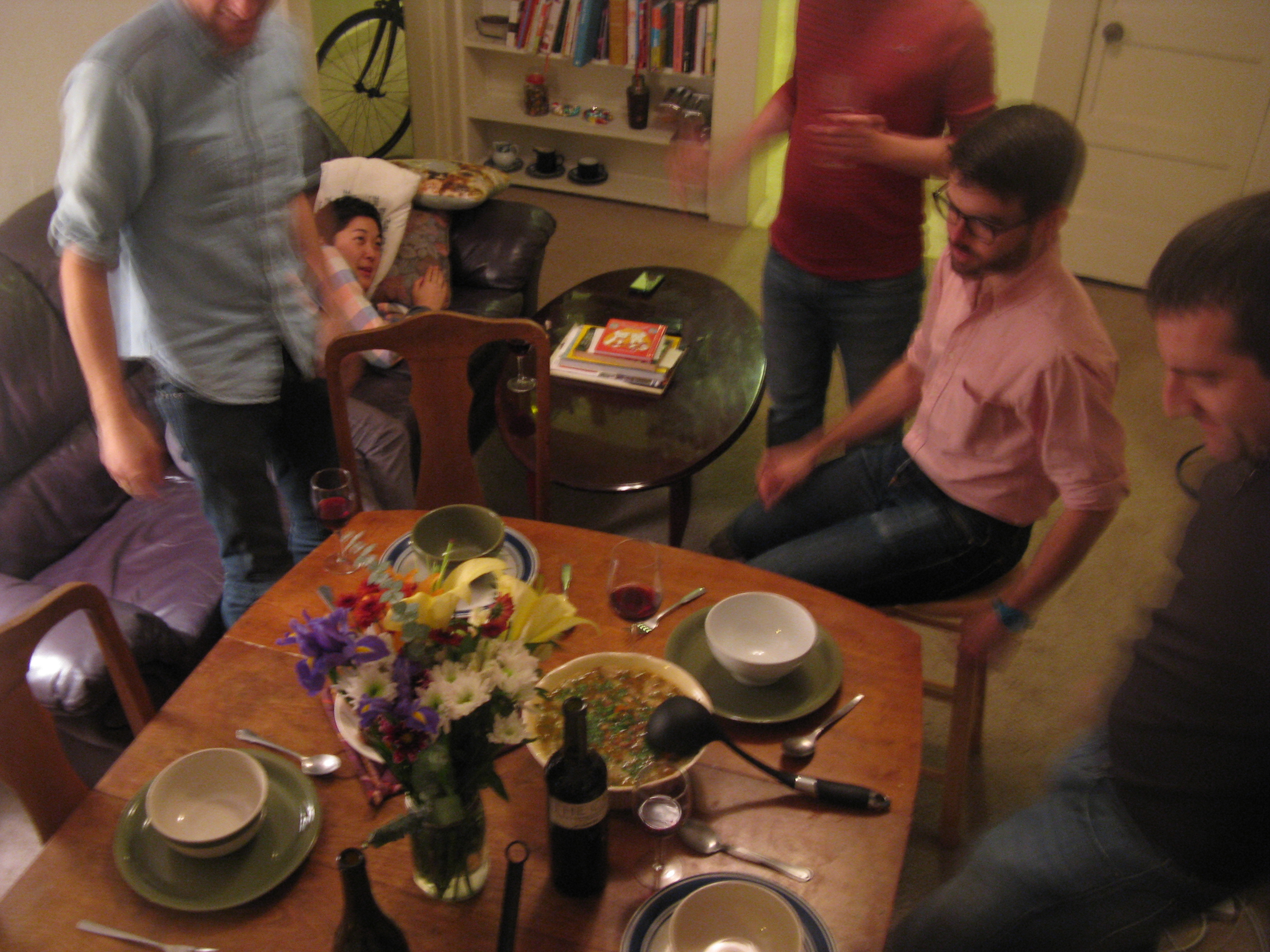
In the end I decided to favor expediency over thematic unity; after all, the show was sold out, so I figured that it wouldn't hurt for us to show up a little early to score some decent seats. Guests at 5:30, dinner at 5:45, dessert at 6:15, leave at 6:45, doors at 6:46, sitting down by 6:49. Those are also the lyrics to the bridge of Rebecca Black's new single. In this picture you can see how fast everybody is rushing to make this dinner party a success. Not surprisingly, we kept perfectly on schedule and scored six seats together near the front, stage left. Sufjan was stage right, but, you know, the theater was dark anyway.
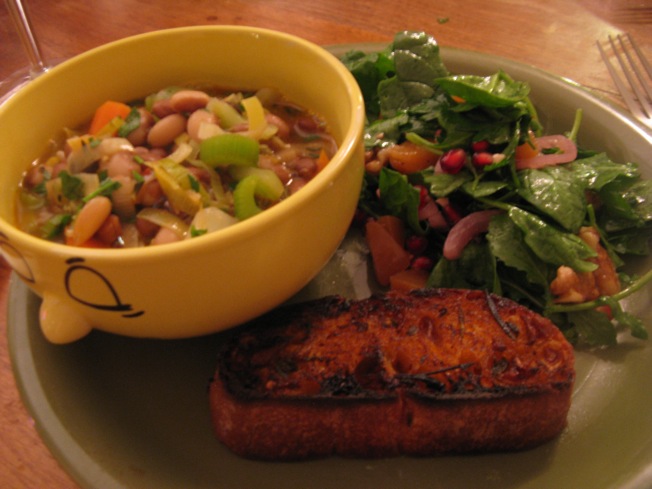
Soup and salad is my go-to menu for a quick, painless dinner party. Consider: what kind of person have I become that I just identified a dinner party menu as "painless?" As opposed to painful? Anyway, soup and salad: comforting, unpretentious, and no problem to make ahead and then assemble in a few minutes when people start arriving. Once you've got everything set up and ready to go, you can focus on more important things, like making an indie rock dinner party playlist, cutting flowers, or matching your six different-colored bowls to your set of six non-matching plates. You can also spare a few minutes to make Magic Bread, which is bread drizzled with Magic Sauce and then placed under the broiler until doves start flying out of the oven.
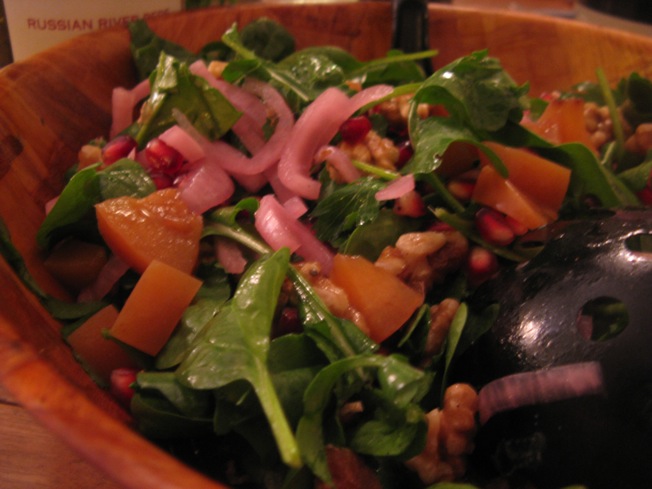
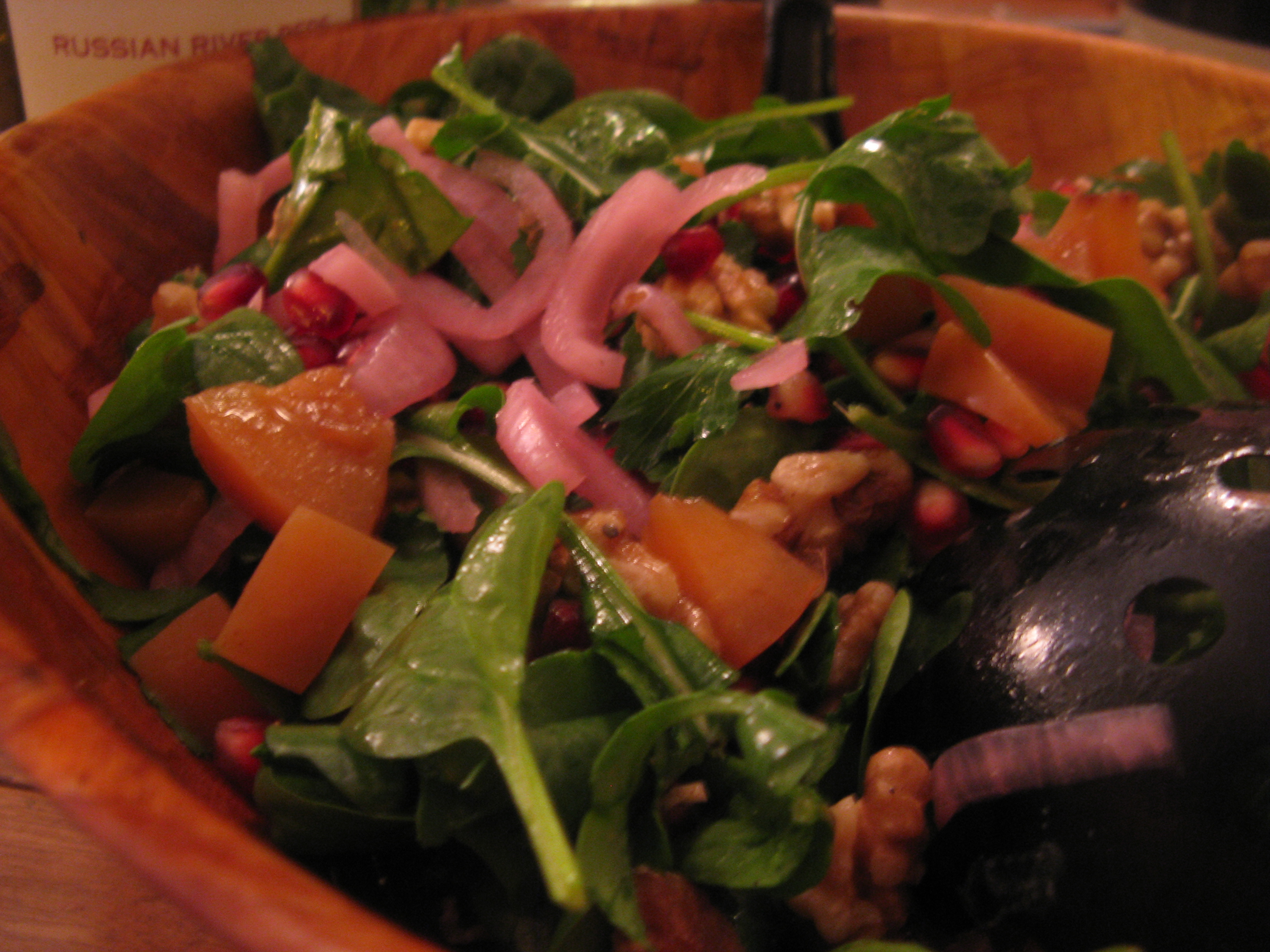
The salad was one of the better ones I've made in recent memory: arugula and spinach tossed with some pickled nectarines, pickled red onions, pomegranate seeds, and toasted walnuts, then bound with a Lillet vinaigrette. Pickled salads are really good for Indian Summer, because they balance so carefully on the precipice between raw and cooked, between the sparkling produce of bright summer and the concentrated, preserved flavors of bleak midwinter. Pickled salads also good when you need to make room for Thanksgiving in your refrigerator and you have seven jars of pickles taking up space on the top shelf. Not that this happens very often.
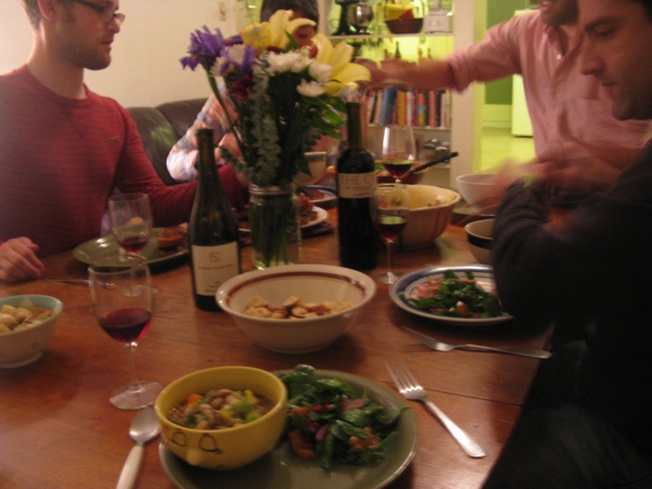
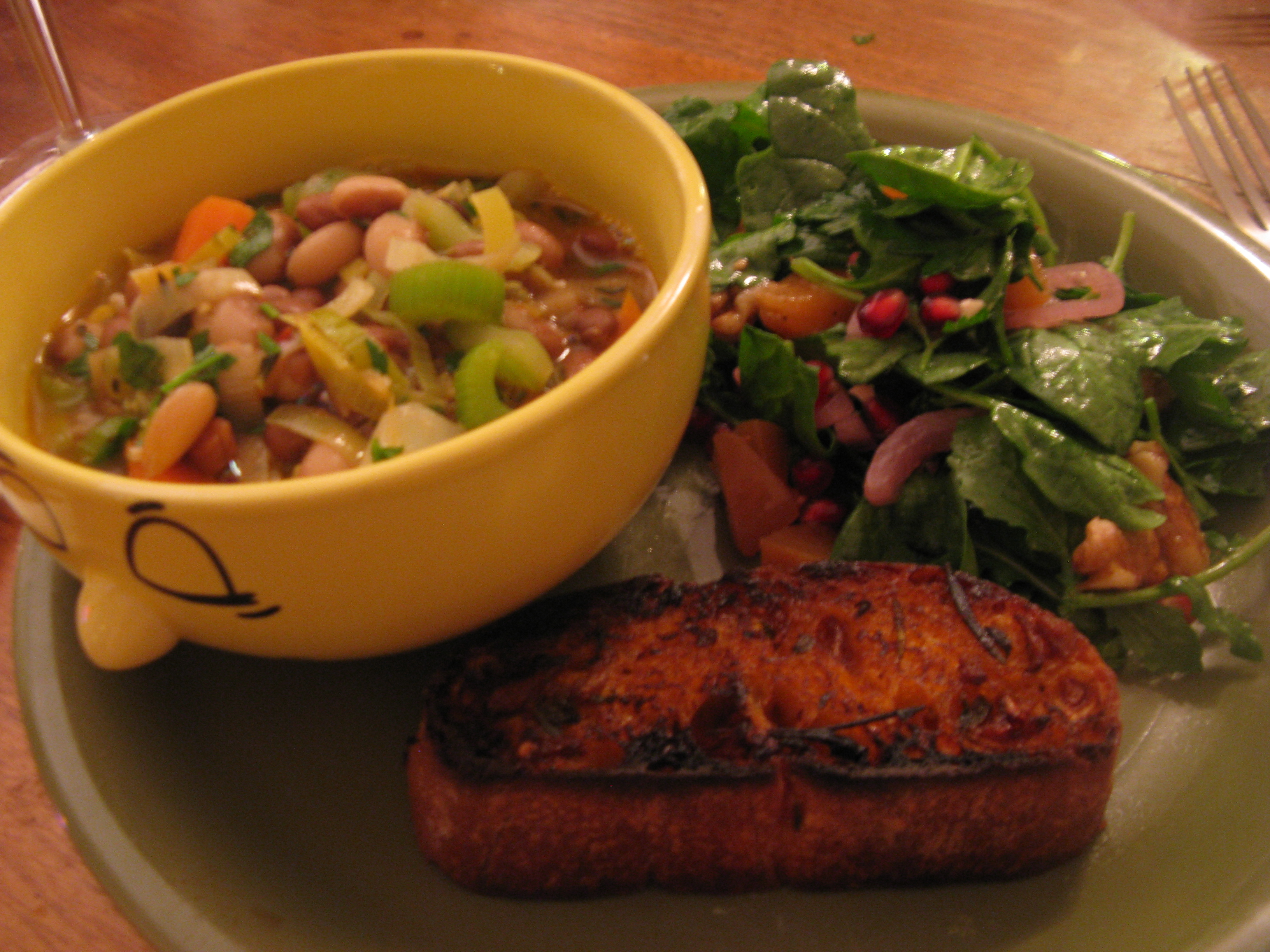
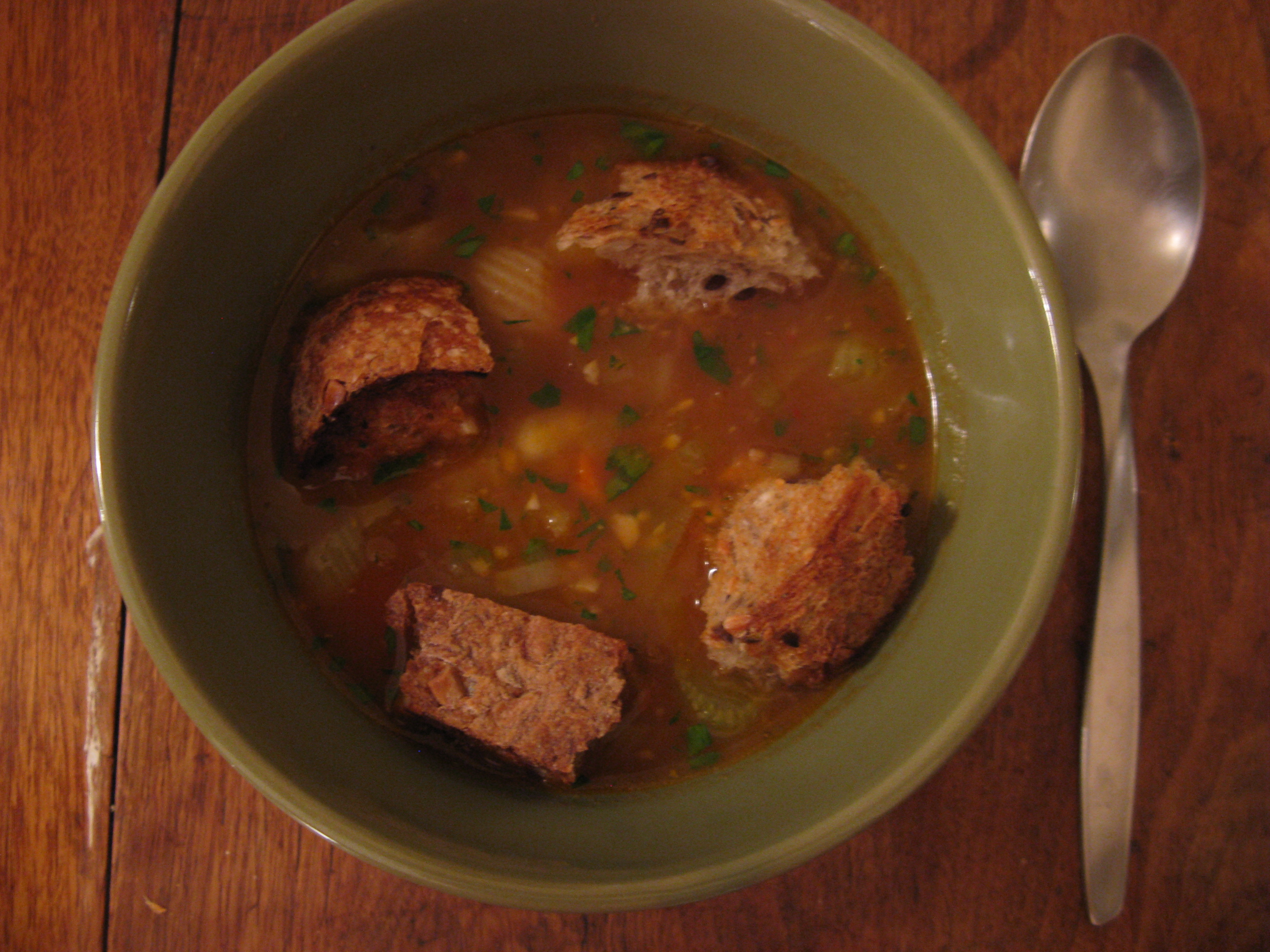
I served the salad alongside a fantastic yellow eye bean soup, which I've made three or four times this year and even blogged about previously. I'll make it again and I'll blog about it again; it's that good. One of the tricks is to cut the vegetables so you get just the right array of textures in every bite: big crisp wings of fennel, tender carrots, crunchy little bits of celery, short noodly strands of leek, and creamy beans. Then, when you're ready to add the broth, add it cold so the vegetables stop cooking. Shut off the heat. Let the sit on the stove for a few hours so the flavors mingle and develop, and then bring it just to a simmer when the guests arrive. No fuss, no timing issues, everything is cooked just right but also suffused with the broth.

And then there's broth. Somehow assertive does not seem to be a strong enough word for this broth. This broth is bossy. This broth is not apologizing for it. This broth is ENTJ. Rosemary, chili, and two full heads of garlic. Not three flavors I would have put together off the top of my head, but after a few sips they make perfect sense, all three delivering the same sort of a kick, just to different parts of the brain. Yeah, that's right, this broth is like three kicks to the brain.
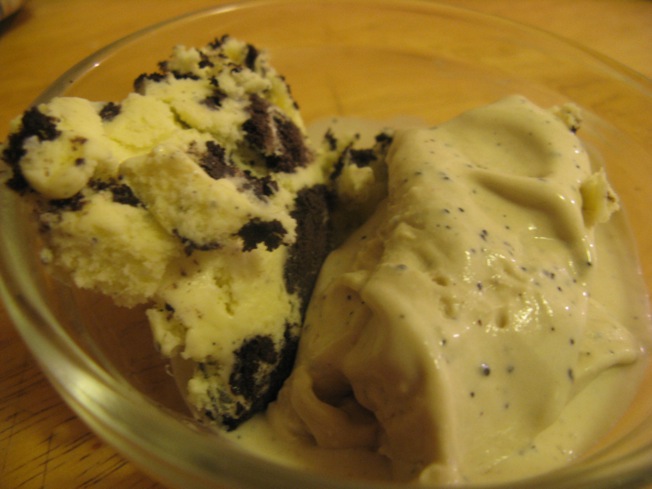
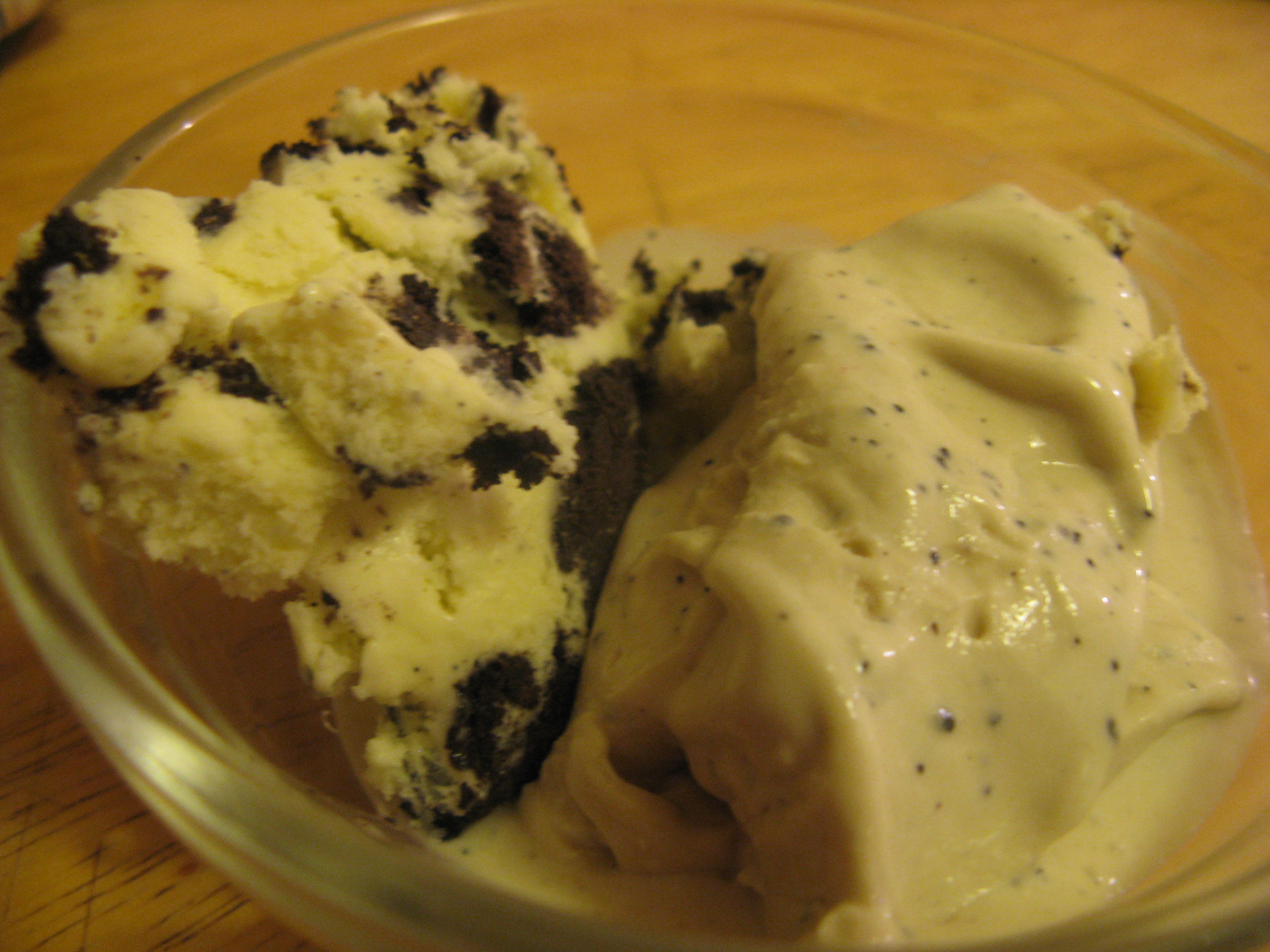
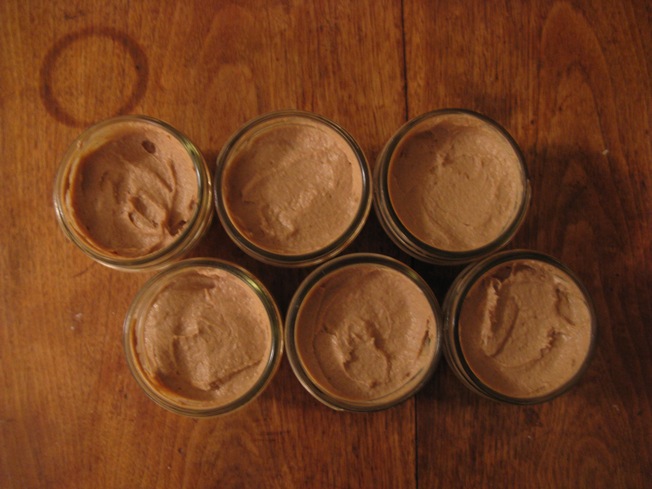
For dessert I just reached into the freezer and took out a few quarts of ice cream that Jeff and I had made earlier in the week (in other news, Jeff and I each weigh 475 pounds now). I was pretty proud of us for managing to serve four different ice cream flavors, none of which paired at all with any of the other three--coffee, ginger, pear-pecorino, and maple-rosemary. Just take my word for it; don't think about any particular combination too long or you might hurl. There had also been some cookies 'n' creme fraiche ice cream (pictured above, at left) hanging out in the freezer, but we finished that up earlier in the afternoon, mostly because it would have paired too well with the coffee. Yeah, that's the ticket.

I realized that I written very much about this dinner party but I have not identified any of the people in attendance--shout out to Elsa, Jeff, Jeff, Ian, and Peter. Thank you all for being a friend and making this evening with soup and Sufjan such a resounding success. Well, I never said this was a people blog.

--

Recipe roundup...

Pickled red onions possibly based on this recipe? Honestly, I'm at a point where I just pour pickle brine over things and hope for the best.

Pickled nectarines from this recipe, which I think calls for a little too much star anise.

I always use this technique for getting the seeds out of pomegranates. It is unbeatable and you don't look like a serial killer.

To make the Lillet vinaigrette, I mixed two tablespoons of Lillet with a teaspoon of mustard and a pinch of salt, then added a quarter cup of canola oil and hit it with an immersion blender until it was smooth, about two seconds (you could also drizzle in the canola oil slowly while whisking, or shake it in a bottle). I then whisked in a tablespoon of extra-virgin olive oil, added black pepper, and adjusted the acidity with a few drops of rice vinegar.

Rustic Rancho Gordo Yellow Eye Bean Soup recipe from Ubuntu in Napa, as published in the New York Times. I followed the recipe pretty closely, but I added fennel to the mix of root vegetables, and instead of the floating garlic toast, I made garlic croutons.

I make garlic croutons by mixing together 3 tablespoons extra-virgin olive oil with 1 tablespoon of garlic oil (to make garlic oil, slice open a head of garlic, place it in a saucepan, cover it in olive oil, and cook over low heat for about half an hour). I cut about half a loaf of ciabatta into one-inch cubes, toss them with the oil mixture, and toast in a 350-degree oven until golden, maybe 20 minutes.

Thursday, September 29, 2011

Cabbage, deadbeef

For some reason I haven't been taking particularly good pictures of food lately. Everything's been turning out a little blurry. I think I must have a case of the shakes. Either that or my camera has a case of the not-focusing-correctlies. I hope it's the former, because that can be treated with a hefty dose of Comanaprosil, while the latter would require purchasing a new camera, and that wouldn't be covered by my student health insurance plan. You know, maybe I'll just lay off the coffee.

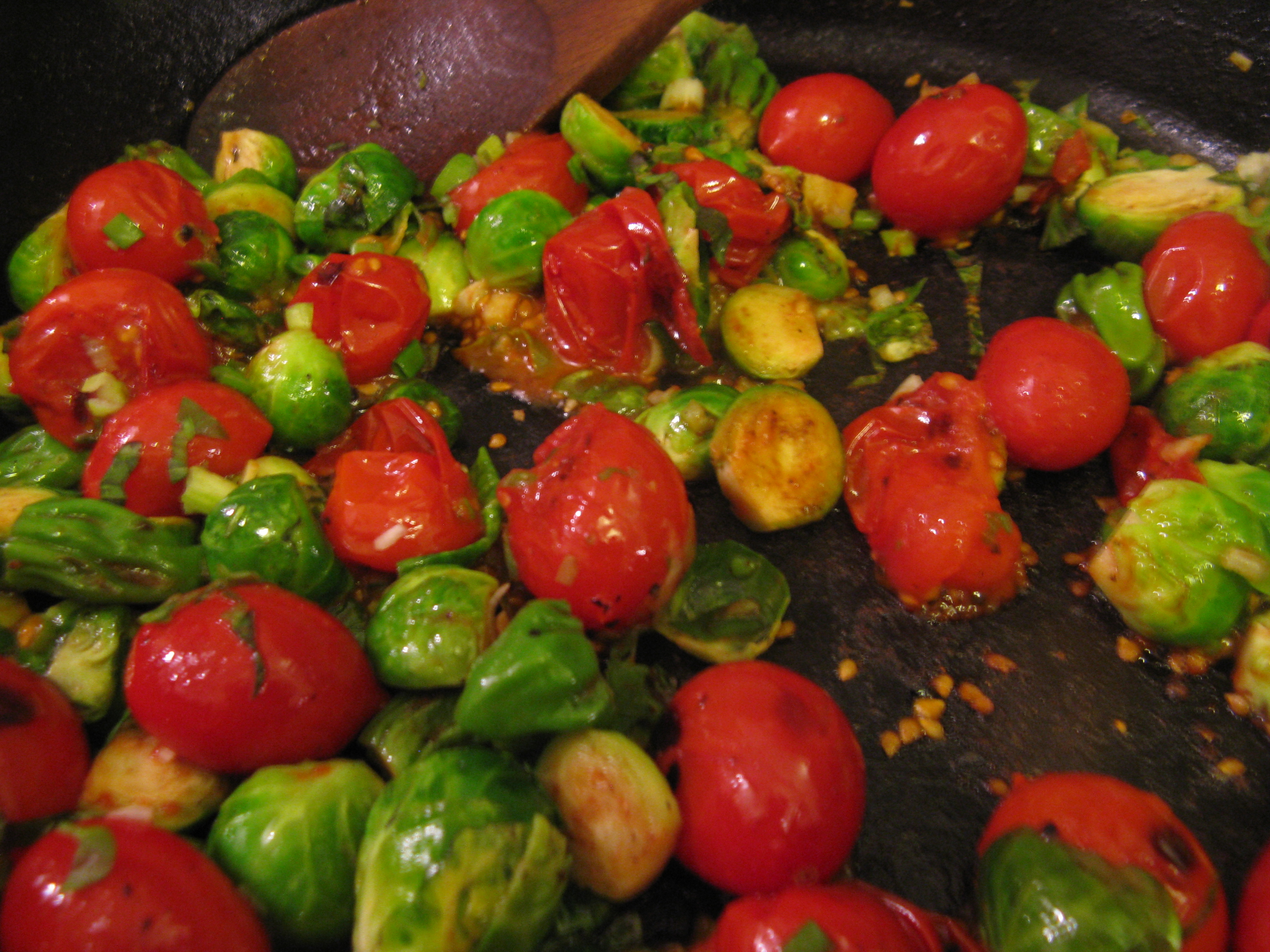
Let me start off by hitting you with my best shot. Here I fried some brussels sprouts, then seared some cherry tomatoes in hot olive oil and mixed the brussels sprouts into the tomatoes. I added a diced green onion and some basil at the end. I don't know quite what I was expecting from the seared cherry tomatoes--maybe like a crisp, bittersweet caramelized exterior exploding into a brisk rush of fresh tomato water--but they didn't quite deliver. Instead they were just like slightly warm tomatoes. Perfectly good, but not matching up to my perhaps unreasonable expectations for this preparation. Okay, next time I will deep-fry the tomatoes after freezing them in liquid nitrogen.

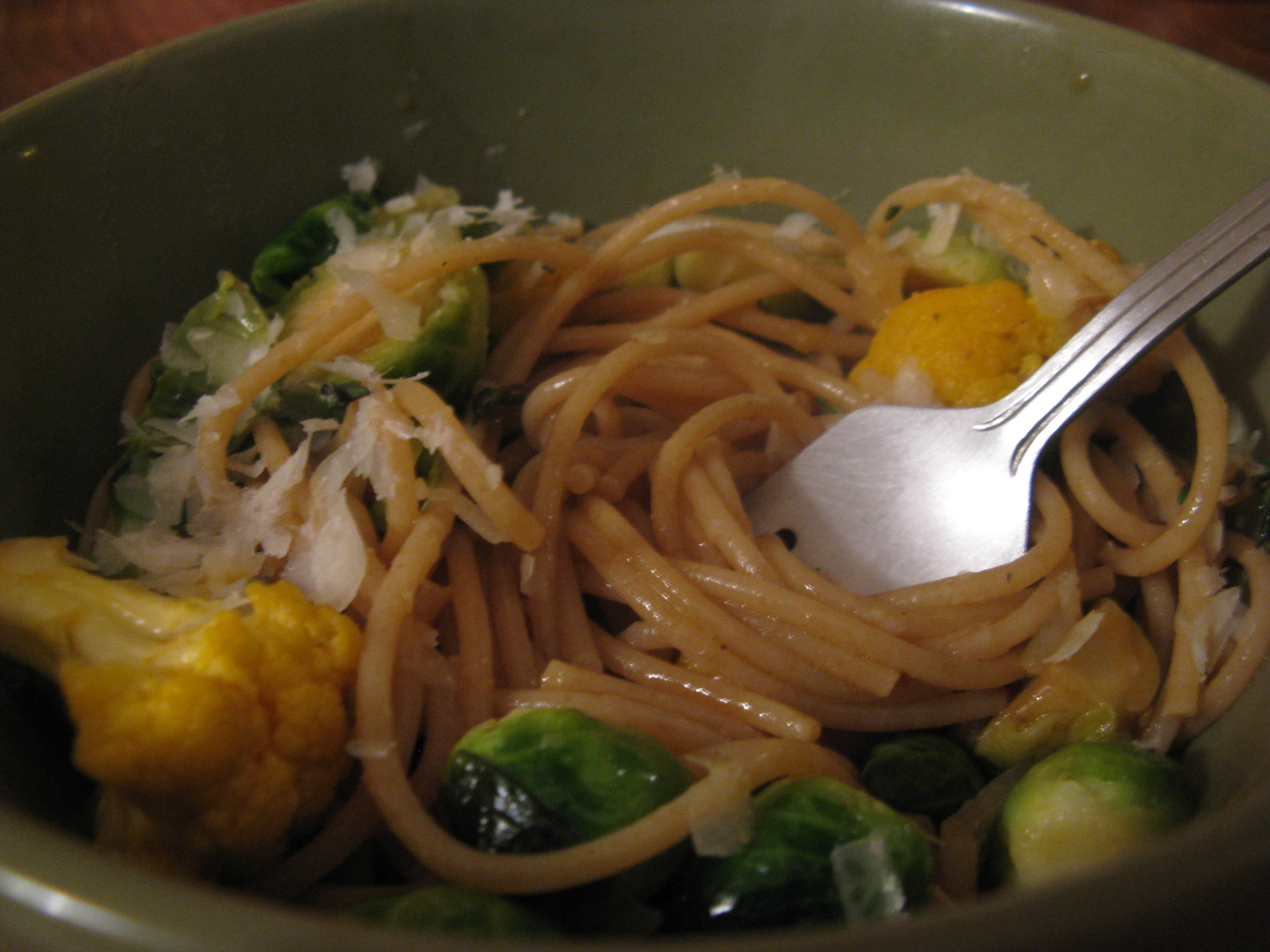
I also used some brussels sprouts in making this dinner, which, if I were to serve it in a fancy restaurant, I might entitle "BRASSICAS, wheat, elements of magic sauce." This blog is not a fancy restaurant so let me just tell you that it's some cauliflower and brussels sprouts that I cooked, maybe with some tomatoes too, and then seasoned with some olive oil, sweet paprika, rosemary, thyme, oregano, lemon zest, and chili pepper (basically everything that goes into Heidi's magic sauce, except deconstructed) and before tossing it all with pasta. Wow, that is a lot of things written out like that. Maybe my initial title was better. Speaking of magic sauce, the other day I had the following conversation with Jeff:

Jeff: cilantro is like the parsley for the countries in the eastme: we haven't had magic sauce for a whole week
I was just thinking that
how have we lived?
Jeff: I was thinking the same thing
like five mins ago

How do I live without you, magic sauce? I want to know.

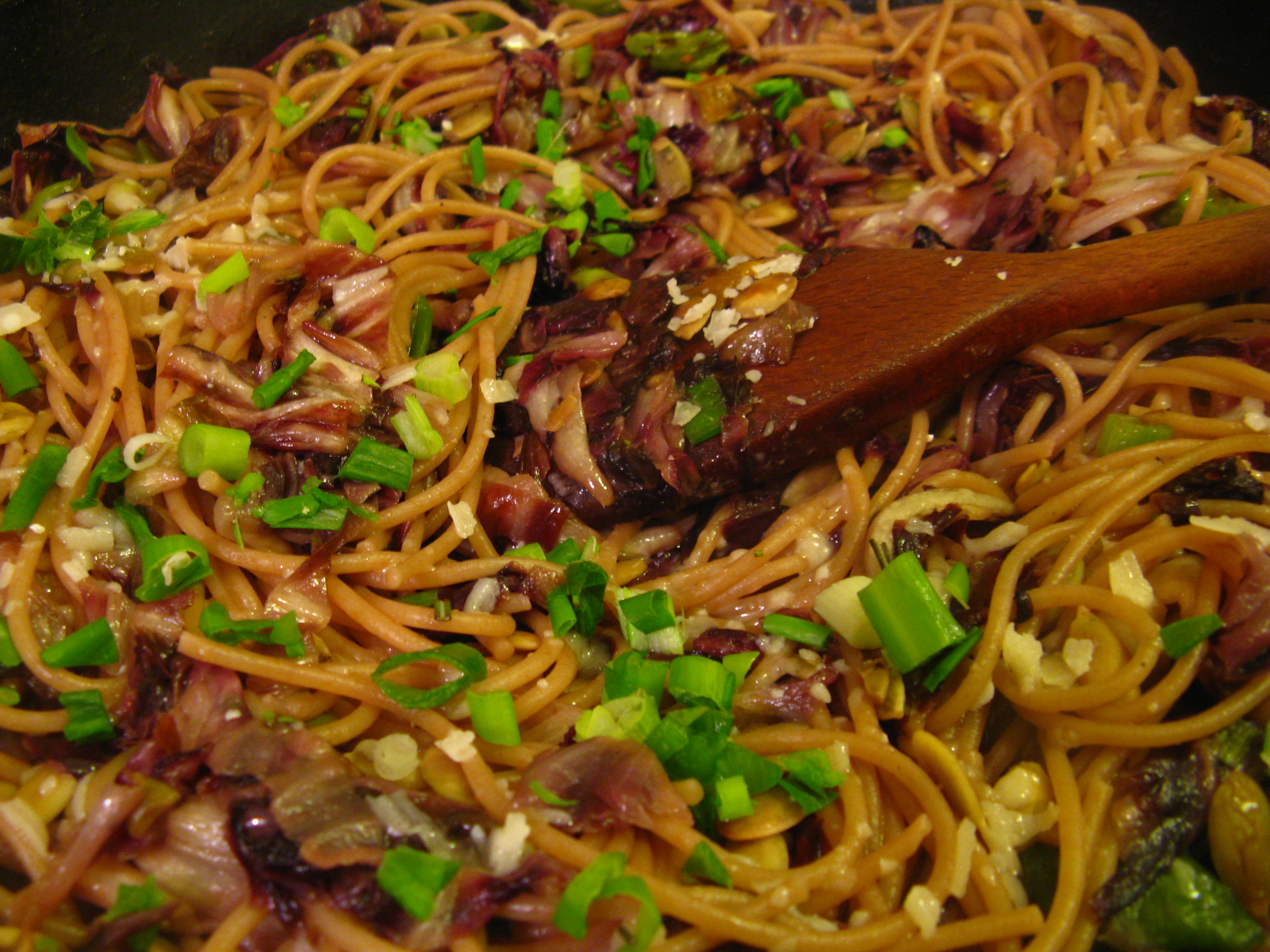
Apparently I have been on a roll taking pictures of brussels sprouts and whole wheat pasta. This was dinner last night: pasta again, this time tossed with some radicchio, pumpkin seeds, seared sweet peppers, rosemary, and a ton of butter. It turned out pretty well, like an oft-told story about a nice steaming bowl of hot buttered noodles punctuated by the occasional bitter crunch of radicchio. The really, really bitter crunch of radicchio. Like, wow, I would not have used a whole head of radicchio if I had known about that bitter crunch. Luckily, the flavors all mellowed together a little bit in the fridge, so having it for lunch today, things weren't quite as astringent. That's a quality to which we should aspire in all lunches: "not quite as astringent."

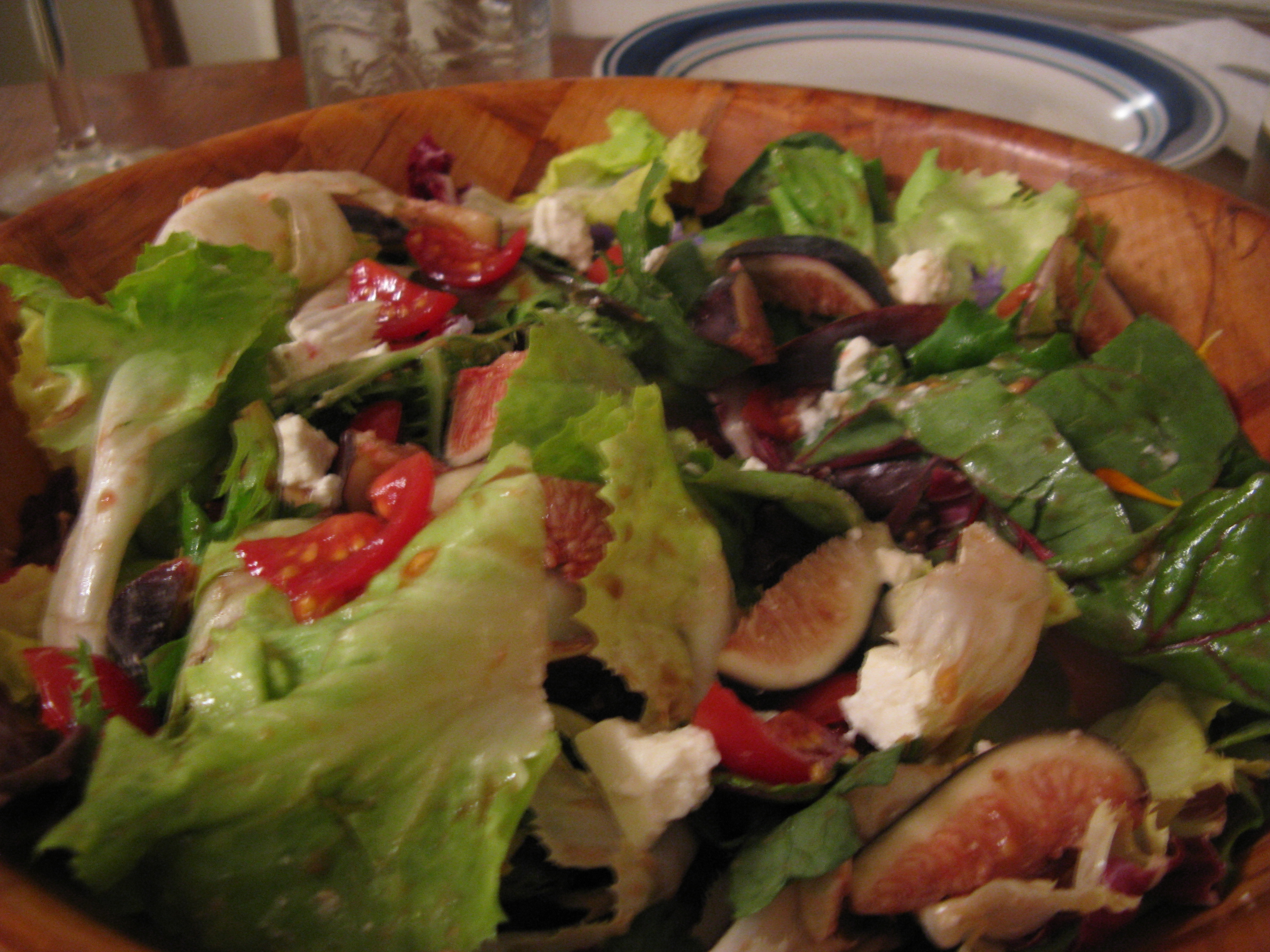
My high school friend Ben was visiting this weekend for a robotics conference and even though he has a $120 per diem for this conference, I decided that it would be easier to make him dinner and enjoy it overlooking the nonstop three-ring circus of Castro St. He did bring over a $119 bottle of wine to make up for it. Ha, no. We started with this salad--escarole, motherfucking edible flower petals, tomatoes, feta, and figs in a balsamic vinaigrette--and moved on to a red and yellow bell pepper risotto, which I was very proud of producing with my favorite risotto technique: pureeing half of the vegetables and stirring them into the risotto at the last minute before serving. The risotto was great and had a ton of sweet peppery flavor (Lillet never hurts either), but the salad was maybe even better: really fresh, tangy, well-balanced, colorful, and pretty emblematic of California in late, late summer.

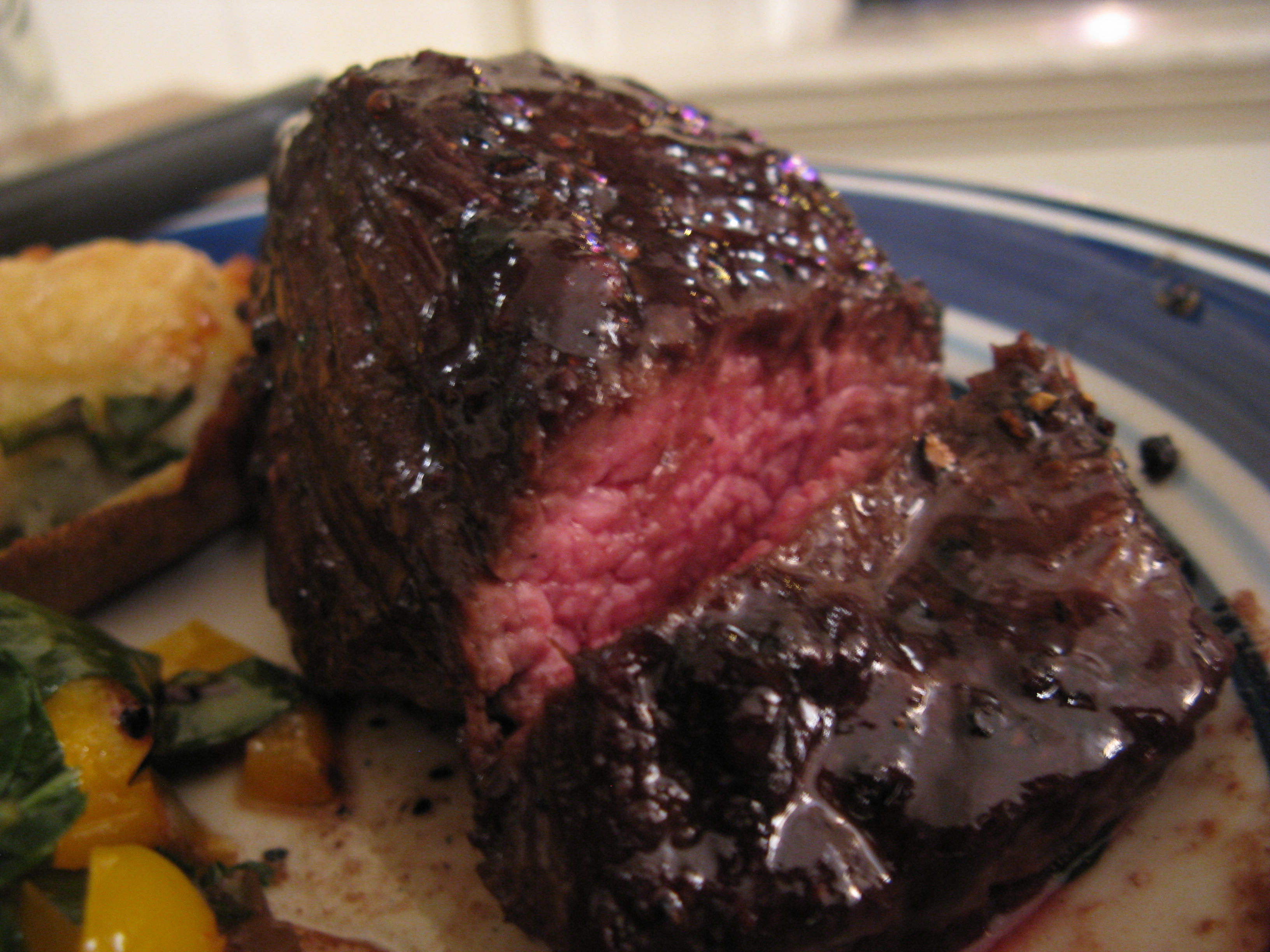
It was the kind of salad, in fact, that I might want to eat before or after a lovely piece of meat such as this bavette steak that Jeff and I made for dinner on Friday. I think it's probably the best steak I've ever cooked; it stomped a mudhole in last year's au poivre. You can see here that it's a perfect rosy pink (thanks to a major assist from Jeff's meat thermometer) hidden inside a nice crispy crust and topped with a reduction of red wine and chicken stock. Jeff made the perfect accompaniments to go along with it--a twice-baked potato and some Portuguese cabbage--and then we had some roasted banana ice cream for dessert. Unfortunately I can't post about that yet but once you see this really awesome post next week that has a ton of Ween references you will totally understand. This is how my brain works.

--

Recipe roundup...

Everything here was kind of off-the-top-of-my-head, but I did look up Kenji's recipe for pan-seared steaks, because I don't cook steak too often. I really dig how he suggests cooking the second side of the steak slowly and continually basting it with flavored butter. I'll probably start doing that instead of a hard sear on both sides.

Jeff's comment on cilantro comes from one of Sandra Lee's delicious recipes

Friday, September 16, 2011

A kind of magic

A few weeks ago I stopped by Berkeley Bowl and bought some Lillet (it rhymes with dill, eh?) for one of Heidi's milkshake recipes, and since then I have discovered that a Lillet goes a long way (that pun would work better if it rhymed with skillet). Soaked into fresh peaches; sprinkled around some ice cream; accenting a melon sorbet; on the rocks with sparkling water and Meyer lemon; mixed with a little ginger ale--the possibilities for enjoying Lillet are as numerous as the possibilities for pronouncing its name.

Sometimes I wonder what motivated me to become a grad student rather than a copywriter for an upscale grocery store circular.

Last night the last few drops of a bottle of Lillet found their way into some green beans I was making, for no other reasons than (1) I was tired of the refrigerator never closing properly because of one tablespoon of wine; and (2) the bottle containing that tablespoon was closer than the rice wine vinegar I was seeking when I opened the fridge. Well, thank goodness Lillet comes in an oversized bottle that kept jamming in my refrigerator door, because this turned out to be one of the best off-the-cuff substitutions I've ever made, the floral sweetness of the wine playing perfectly off the beans and some earthy pumpkin seeds. From this day forward, I will be less suspicious of recipes that claim to have been conceived in similar bouts of inspiration. Maybe Gwyneth Paltrow really was compelled to throw an impromptu garden party with only $40 worth of tuna steaks and a pack of hot dog buns in her pantry.

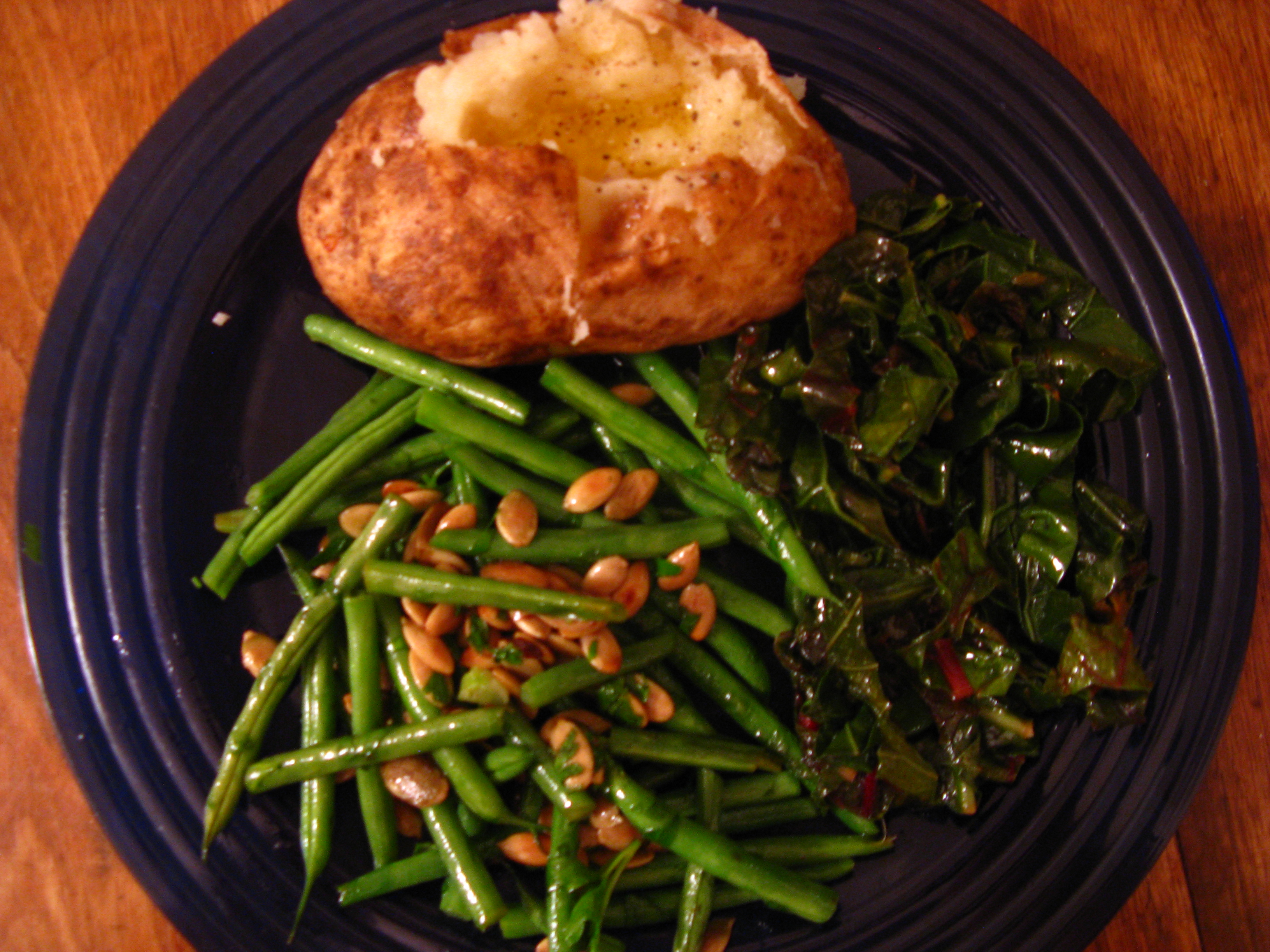
The beans turned out so well that I thought today might be a good opportunity to highlight a typical weeknight dinner for Jeff and me. A hill of beans, a handful of dark greens tossed in magic sauce, and a baked potato, which in this picture awaits a final drizzle of creme fraiche. Granted, this is a superb specimen, the dinner to which we always aspire. We have to make do with whatever happens in the kitchen. Sometimes the zucchini gets a little soggy, sometimes the sauce doesn't quite stick to the noodles, sometimes you make too many ravioli and not enough Brussels sprouts, and sometimes you're too tired to make anything other than magic sauce drizzled on bread. Well, I think that's still a valid dinner.

Jeff says: "What's that? You haven't tried Heidi's magic sauce yet?" Let me link to it again. It looks like it's just your everyday infused oil, but like so many of her recipes, it ends up bringing so much more to the table. The sharp rosemary plays off the red pepper, the lemony tang of oregano complements the even-more-lemony tang of, um, lemon zest, and sweet paprika and thyme give a firm backbone to the olive oil. With this happy clashing of herbs and spices, it tastes like it comes from some far-off European country that you just can't place, like maybe the same one Johnny Bluejeans is from. It enhances anything it comes in contact with, edible or not. Even storing it in your kitchen automatically improves all other meals that you cook there. It has brought down the mighty from their thrones, exalted the humble, and filled the hungry with good things.

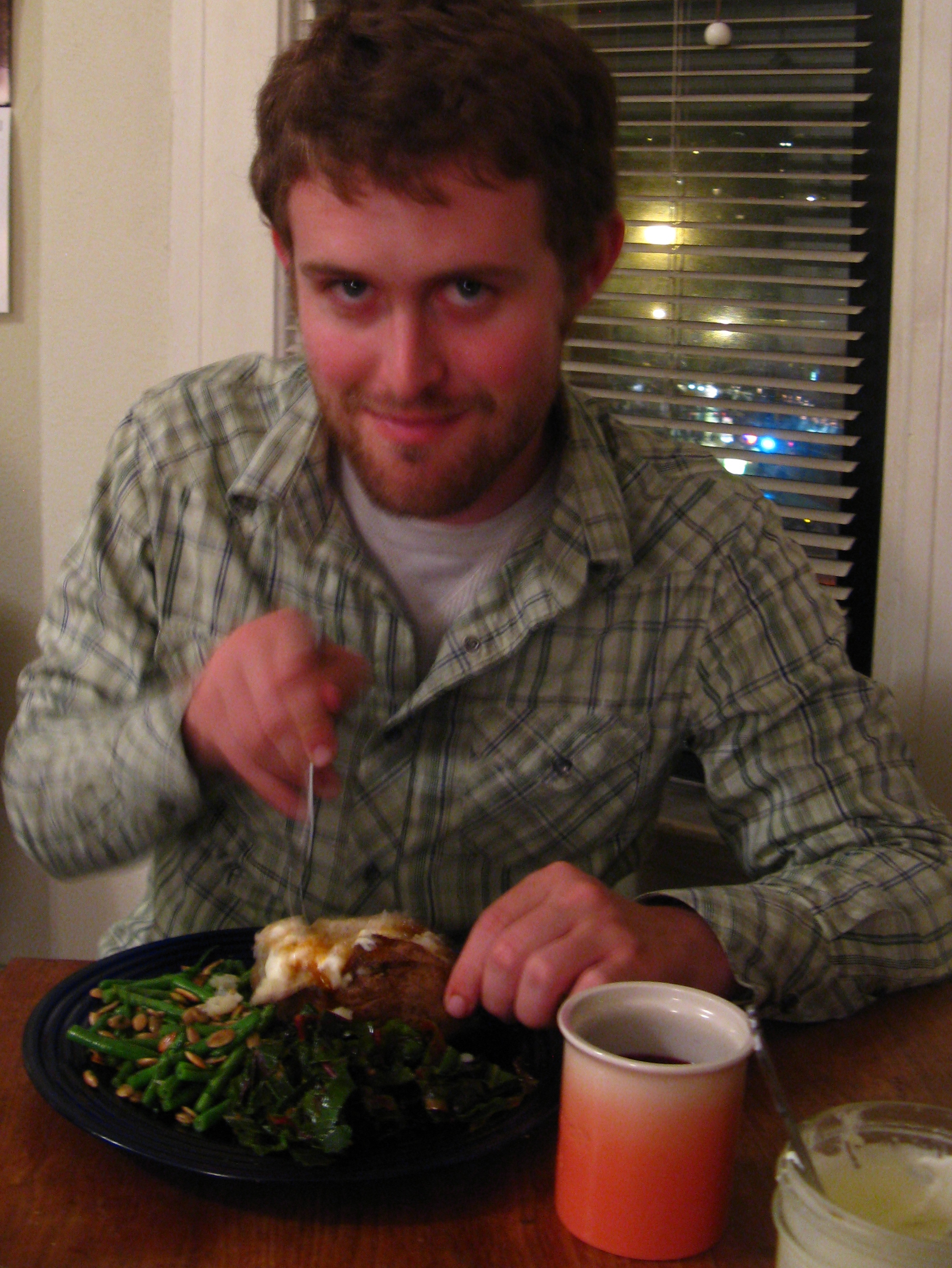
Actually, Jeff was saying: "Are you really going to take pictures of dinner until I've finished eating my entire baked potato?"

--

Recipe roundup...

I think the potato and the greens are pretty self-explanatory, and the magic sauce I have linked three times now.

Here's how I made the green beans.

Haricots verts avec Lillet et pepitas

2 cups green beans (fancy thin ones preferred)
half a cup of pepitas
2 tbsp Lillet
2 tbsp Italian parsley leaves, finely chopped
olive oil, salt, rice wine vinegar

Twist the stems off the green beans and cut them in half if they're pretty long (mine were). Toast the pepitas in a dry pan over medium heat, shaking pretty frequently. Depending on your stove, it might take 5-7 minutes. Pour the pepitas into a bowl and set aside. If you're good, you can do these two steps simultaneously, but don't blame me if your house burns down, clumsypants.

Heat a tablespoon of olive oil in the pan over medium-high heat until it's very fluid but not smoking. Add the green beans to the pan and start frying them, shaking or stirring constantly so they don't brown. Add a big pinch of salt. If the beans aren't all shiny with oil after you've shaken them a few times, you can add a little more oil to the pan. After frying them for about a minute, turn the heat down to low and let them cool for a minute.

Add the Lillet and cover the pan. Cook over low heat just for two minutes or so, until the beans are cooked through but still pleasantly crunchy. Keep testing them--this isn't an exact science, and you don't want them to lose their brilliant green color. This is a good time to chop the parsley leaves if you haven't already. Once the beans are cooked, add the toasted pepitas and the parsley. Shake the pan to mix everything together, taste a bean, and adjust the seasoning with salt and rice wine vinegar.

Monday, August 8, 2011

Don't be distracted

This was a particularly busy weekend for Jeff--he had two handbell concerts and a handbell dinner celebration, and he also had to work overtime on Sunday to help relocate his office. Each time he left the apartment I put forth some sort of vague proposition toward imagined productivity--"Okay, cool, I'll clean up around here while you're gone" or "Oh, yeah, maybe I'll do a little laundry this morning."

But, well, you know me.

So my original cooking project for the weekend was to prepare this chicken liver mousse from Frances. A duck liver mousse had been a highlight on a previous visit (and is the current teaser picture on their website, served with APPLE BUTTER), so I was overjoyed when the recipe showed up in the Chronicle a few weeks later. On Saturday afternoon I went out to buy some supplies for that. And, well, you know how things can just snowball? Oh, look, Mission Meat Market sells chicken backs--maybe I should buy some for stock. Hey, we still have some eggplant leftover from the farm box--how about some baba ghanouj? Four hours later Jeff was home from handbells, down on his hands and knees in the bathroom, scrubbing off all the dirt that I had spattered everywhere while unpacking my camping tarp, and I was in the kitchen pushing chicken livers through a sieve. I am awesome.

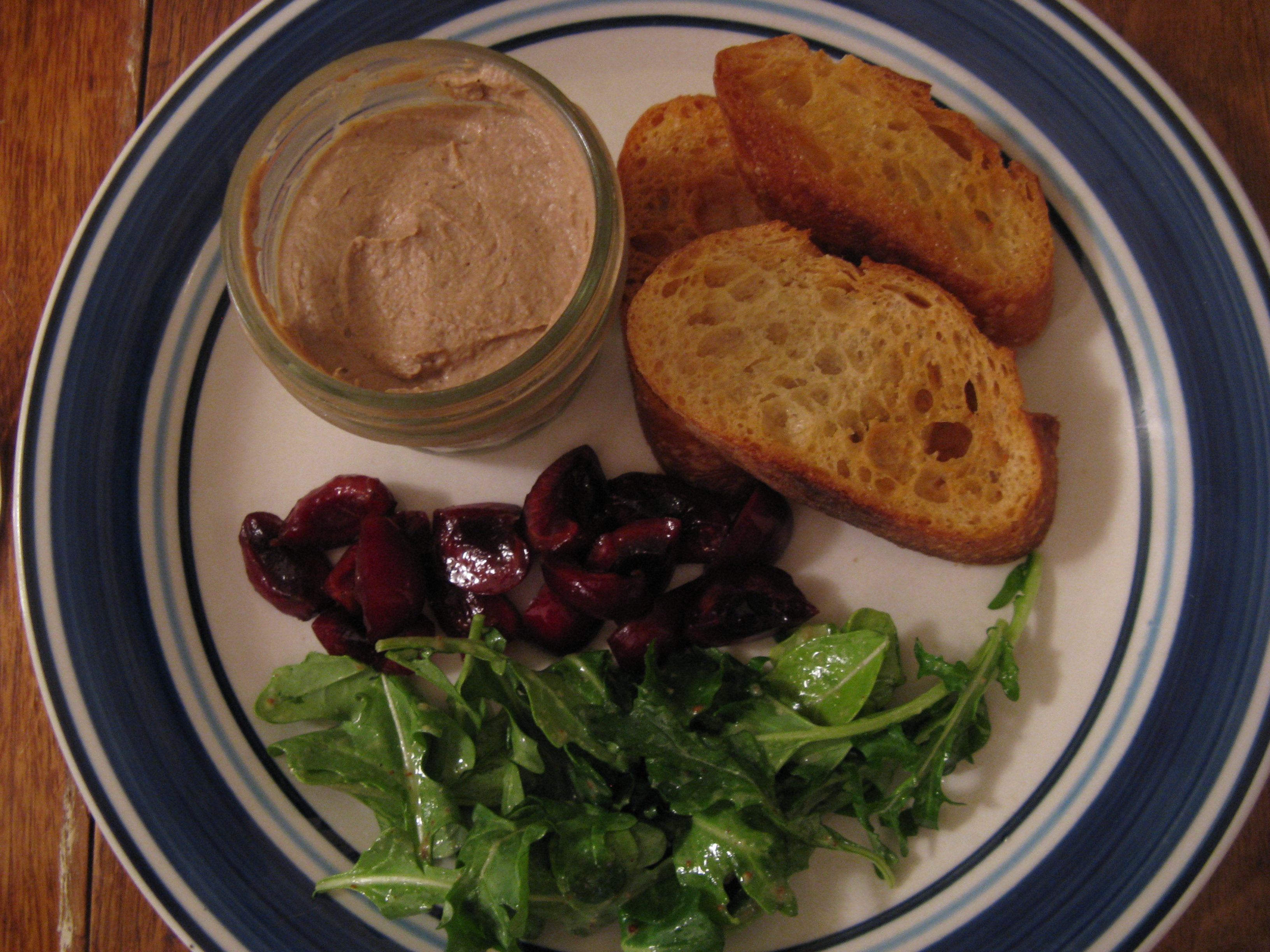
So maybe I didn't do so well with my chores on Saturday night. But that mousse I made? Sure was excellent. Probably one of the best things I've ever thrown together in the kitchen. I served it with some extra-crunchy baguette slices, tarragon balsamic cherries that I pickled last month, and a little arugula salad in a mustard vinaigrette. Having my hand in every element of the dish was pretty instructive as far as why this is such a classic pairing--eating the liver mousse alone (off of a spoon, off of the food processor blades, off of your fingers), you really do feel that for all its astoundingly smooth richness, it's missing something crunchy. Then you get that crunch and--oh, how about something sweet? How about for something sour? I learned something today.

As it became clear that my weekend would be consumed by some sort of weird obsessive-compulsive cooking ritual de lo habitual, I put out an APB for an impromptu dinner party Sunday night. I have to say that I felt a little awkward when our friend Nghi showed up in gorgeous Chanel flats--not because I was underdressed at my own dinner party, just because "sweep the kitchen floor" was another household task that never quite rose to the top of my to-do list, and I wasn't sure if it would be less gross for Nghi to get those flats dirty or to stomp around barefoot. Hopefully I made up for the mess by serving a bean soup based on a recipe from Ubuntu, a tremendously fancy "community-focused restaurant and yoga studio" in Napa. In fact, I think it is the only Michelin-starred combination restaurant and yoga studio in the world. Or, at least, it's the only one where a salad costs $16.

Speaking of pricing, I'm not quite sure which would cost more--replacing Nghi's Chanel shoes or dinner for three people at both Frances and Ubuntu--but I do know that the soup turned out really well. The bracing aroma of rosemary, chili, and two heads of garlic was so enticing that when I dove into a tupperware full of the soup for lunch this afternoon, my coworker Colin headed over to the fridge, deadpan: "Okay, I have to eat something now because that smells so good." Maybe slip an expletive in there too.

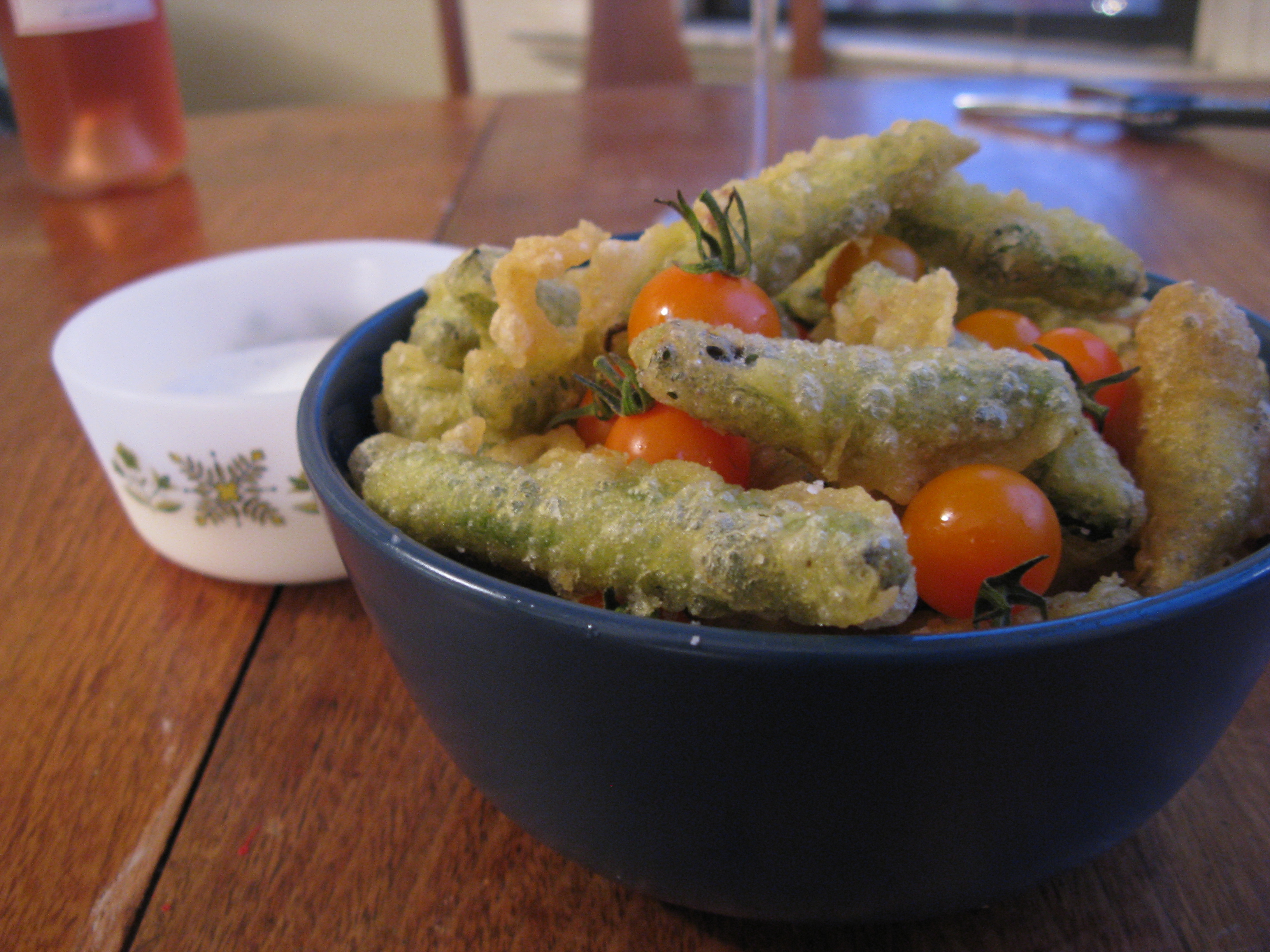
Another totally essential thing that I did this weekend: I took a tour of six grocery stores to see which of them the best place to buy produce near my apartment. No, really, this is how I spend my life. Conclusion: while I don't think that I'll be giving up the occasional evening-commute visit to Berkeley Bowl anytime soon, I really dig a lot of things about Rainbow Grocery on Folsom, particularly these adorable baby fava beans that I found this weekend. I did a little fritto misto with them, or perhaps a fritto solo, and tossed them with some most excellent sun gold tomatoes (my single favorite food in the entire world), also part of my haul from Rainbow. The baby favas weren't quite exploding with concentrated fava flavor as I had hoped, but dipped into a little fennel-spiked creme fraiche, well... how bad can that be?

This entry was brought to you by the colon.

--

Recipe roundup...

Chicken liver mousse as served at Frances, recipe reported by the esteemed San Francisco Chronicle
Fritto misto batter and potted bing cherries with balsamic vinegar from Ad Hoc At Home
Rustic Rancho Gordo "Yellow Eye" bean soup as served at Ubuntu, the recipe reported by the New York Times

Thursday, August 4, 2011

How I make ... gazpacho


This recipe makes a truly rich, refreshing chilled raw vegan soup out of excellent summer fruits and vegetables. You could skip the fussy extra steps of sieving the soup and then blending in the olive oil, but you'll miss out on its distinctive velvety texture. If you've got the hardware handy, give it a shot and see if it isn't worth your while.

Adapted from the recipe for sun gold tomato gazpacho from Ad Hoc At Home by Thomas Keller

INGREDIENTS

1 cup cold water

2 lbs juicy summer produce (tomatoes, melons, stone fruit)

1 1/4 lb crisp summer produce (cucumbers, zucchini, summer squash, bell peppers)

salt

citrus juice / vinegar
olive oil

METHOD

Pour the water into a bowl and add a generous pinch of salt. Prepare the produce (core tomatoes, peel melons, seed cucumbers and squash), chop into 1-inch pieces, and add all produce to the bowl, starting with the crisp produce first so it spends more time marinating. Stir to completely coat the produce and let marinate 5 - 10 minutes.

Puree the mixture of produce and water. I use Jeff's heavy-duty food processor, but you could also use an immersion blender or a regular blender. Either way, it will take a while--I'm telling you right now that it's going to take longer than you think, so get those biceps ready if you're using an immersion blender. When you're done, the soup should be pretty close to smooth. If you're making the proportions listed, expect it to take 3-4 minutes.

Pass the soup through a fine sieve. Not much should be stuck in the sieve (only tomato and pepper skins, maybe some seeds if you didn't seed your squash completely) and the strained soup should be relatively thick. Taste the soup and add some salt and a few drops of vinegar/citrus juice to taste. Not too sour! A few drops will pick up the flavors of the vegetables; add more you'll have vinegar soup.


Wipe out the original food processor, blender, or bowl, and pour the soup back into it. With the food processor or blender running, slowly add olive oil to the soup and blend to achieve a smooth, velvety texture. Ad Hoc At Home suggests nearly a cup of olive oil for the listed proportions, but I usually find that 1/4 - 1/2 cup is sufficient; more than that seems to dominate the flavor of the soup and give it an unpleasant, oily texture.


Serve cold, garnished with additional finely diced raw vegetables and fresh herbs. Makes 4-6 servings.


VARIATIONS


Mix in one quarter of an onion and/or 2-3 cloves garlic--not too much, or the raw, pungent taste will overpower the rest of the vegetables.


Let the gazpacho sit overnight in the refrigerator. This results in a mellow, unified flavor that I prefer to fresh gazpacho. You'll probably need to hit it with an immersion blender to re-emulsify it before serving.


Don't strain the soup for a more rustic texture.

Add breadcrumbs or torn bread to the original mixture for a thicker soup with a deeper flavor.


IDEAS


Ad Hoc At Home sun gold tomato gazpacho -- For the juicy produce, use whole sun gold tomatoes. For the crisp produce, use one yellow bell pepper and some armenian cucumbers. Add also red onion and garlic. Garnish with cucumber, red bell pepper, sun gold tomato, chives, and a drizzle of olive oil.

Mariquita late July gazpacho -- Use San Marzano tomatoes for the juicy produce and a mixture of summer squash and red bell pepper for the crisp produce. Garnish with diced red bell pepper, sliced padron peppers, and creme fraiche.


Colorful watermelon gazpacho -- Use watermelon for the juicy produce, red bell pepper and peeled cucumber for the crisp produce. Add red onion and no garlic. Garnish with quartered sun gold tomatoes and a bright green cucumber-herb granite.

Yellow gazpacho -- Yellow tomatoes, yellow summer squash, yellow bell pepper, sweet onion.


Green gazpacho [?] -- Try using green beans for some of the crisp produce. Garnish with yellow peaches. Not sure if this would work.


Top any gazpacho with a fried green tomato... might provide a nice contrast to the whole raw vibe that gazpacho has going on.

Oh, how about papaya and green papaya? Wouldn't that be fusion-tastic?