Showing posts with label winter. Show all posts

Sunday, December 8, 2013

Five years

On Friday night, Jeff and I celebrated five years of knowing each other with a trip to local gem Frances, which once again exceeded expectations:  clams baked in cream, seared cod balanced against the bitter crunch of romanesco, midnight-black chocolate cake studded with pears.  We'd been planning to grab a cocktail in the neighborhood beforehand, but, as Bowie once sang, it was cold, and it rained, so I felt like an actor.  Honestly, I think we make better cocktails at home than anywhere I that I would want to walk on a rainy night anyway, so we mixed up a few aperitifs while we were peeling out of our wet biking gear and making ourselves presentable for dinner.  Jeff, as always, went for a boulevardier, while I decided to put a kettle on the stove, knowing that any drink I was going to make at this point would require hot water in some capacity.  I've been going through a Terroir gin phase recently, and having recently read an article about tempering gin with applejack, I wanted to see if I could do some sort of a warm riff on a Pink Lady with those ingredients--maybe sort a cross with a hot toddy.


I usually load my hot toddies with a Dutch trading vessel's worth of spices--eight inches of ginger root, a handful of cloves, a few sticks of cinammon, and some sichuan peppercorns for mouth-numbing good measure.  They're delicious drinks, and they'll warm you up fast, but at the end of the day you really can't tell what kind of alcohol they're spiked with, be it bourbon, rye, cognac, or even hot buttery rum.  Really, you could probably pour a fifth of Nyquil into one of my hot toddies and it'd taste about the same.

This time I decided to take more of a spirit-forward approach, dialing down the extra flavorings to only a pod of anise and a sprig of thyme, and accenting the drink with just a dash of honey and lemon.  The bracing pine aroma of Terroir took on a totally different character while warm, and enveloped in the richness of applejack, it actually didn't seem too unusual for a warm drink.  Comforting but not rustic, nutty yet slightly savory, this is one of my best drinks I've made in recent memory.  Stuck on my eyes; what a surprise.

--

Five Years

1 oz. Laird's bonded applejack
1 oz. St. George Terroir gin
0.5 oz. lemon juice, strained (about half a lemon)
0.5 oz. honey (about 1 tbsp)
a one-inch sprig of thyme
one star anise pod
4-5 oz. boiling water, plus extra to warm the glass

Fill a mug or sturdy glass with hot water and let it sit for 30 seconds to warm it.  Pour out the hot water.  Add the applejack, gin, lemon juice, honey, thyme, and star anise to the mug, then pour the 4-5 oz. boiling water over top.  Stir, taste, and add a little more honey if necessary.  Sip. 

Wednesday, March 28, 2012

It sounds more made up

I don't know if you realize how many holidays there are in the middle of the month of March. For example, March 14th is Pi Day. And you can go on all you want about how pi is actually not a physical construct and how we should be celebrating tau day on June 28th to be consistent mathematically with various other equations, but I am personally in favor of any holidays recognizing Greek letters that are homonymous with popular American desserts.

On this year's Pi Day, Jeff and I finished up a noncircular dinner and then headed over to the new barbeque joint on our block to grab the shaker lemon pie they had advertised on their online menu. After checking with our server that they had this specific pie in stock before sitting down, Jeff and I took another look at the menu and then decided that the butterscotch pudding with candied bacon also sounded like a good deal. Five minutes later, our server returns, looking horrified: "We're out of pie." We explained that it wasn't a huge deal and that the auspicious date likely had something to do with their unexpected demand for pie that evening. Still, the server was nice enough to bring out a dish of apple cobbler that didn't appear on our bill, explaining that cobbler is basically just smashed-up pie. I think from now on, whenever a restaurant is out of the dish I want, I'm just going to make up a national holiday for that dish, so that they give me a different dish for free. Sorry, it's prime rib day. October 12th. (We left a big tip.)

Then the day after pi day, March 15th, is The Ides of March, which is also Sam's Mom's Birthday, and is also The Day Yosemite Reservations Open for Summer. Depending on who you are, all three of those have the potential to be either very delightful or very stressful. If you are Julius Caesar or someone who likes camping but has a job, it usually turns out to be a very stressful day. Because if you want to stay in Yosemite Valley or Tuolumne Meadows sometime between July 15 and August 15, you're going to have to synchronize your computer with the giant clock on the face of Half Dome, stake out your virtual campsite, and start turbo-clicking "reserve" from 6:58 AM PST until a month's worth of campsites in Yosemite National Park are all booked up. That will happen at about 7:15 AM PST. Well, it could be worse; you could be Julius Caesar.

Despite some (literally) last-minute computer snafus, Jeff and I successfully navigated the Yosemite logjam once again this year and I decided to make egg-in-the-hole to celebrate. I once read that egg-in-the-hole is the only food that Brian Wilson of the Beach Boys knows how to cook for himself at home. I have to say that I'm just a little bit incredulous, because (1) as one of rock music's most infamous perfectionists, you'd expect him to be a pretty good cook, just sitting at home making omelets and practicing theremin all day; and (2) making egg-in-the-hole is actually one of the hardest things I can think of. You have to cut some bread to the perfect thickness, hollow out a hole of the exact right volume, fry it over the most delicate heat until it's perfectly browned, deftly slip in a single egg, let that cook just until the white just shows the barest hint of coagulation, gently lift it but forcefully flip it, pray, and then lift it onto your plate without the whole affair just falling apart into a puddle of yolk and shame. It requires a lot of concentration and a lot of finesse, but I think if Brian Wilson could write the harmonies to "California Girls," he can probably handle it.

And then two days after the Ides of March, it's St. Patrick's Day. Jeff and I had a small, casual get-together that began with this art deco cheese plate I prepared: oat soda bread, tomato jam, Irish cheddar, and Kerrygold butter. The oat soda bread, based on a recipe from Heidi and fortified with hazelnut meal is one of the best things I have ever baked and fortified with hazelnut meal for extra protein. I vowed to keep a loaf in our apartment at all times. I have not made it since then.

From there, we progressed to this lovely Irish beef stew that Jeff made. It has Guinness in it, of course, as well as some prunes (apparently an Irish thing) and some parsnips (unfortunately an Irish thing), some pearl onions and some mushrooms, and all the other usual suspects of beef stew. Honestly, I don't even ask what Jeff puts into things he braises anymore because they all turn out wonderful and tender. I may or may not have rewritten the lyrics to a Nicki Minaj song to celebrate Jeff's prowess for braising meat.

And here is a raw marinated kale and cabbage salad I prepared as the counterpoint to that Super Braise. What I actually wanted to show you hear was a picture of the dessert I had made, a "whiskey ginger" float that paired homemade ginger ale with Irish whiskey, ginger ice cream, and a topping of vanilla whipped cream. I was pretty proud of finally making a ginger syrup that had enough ginger in it to satisfy me; it only took twelve ounces of ginger and another tablespoon of sichuan peppercorns, just for that little hit of novocaine in your soda. I had everything all bubbled up and mixed together--and then my camera ran out of battery. It was a huge bummer, because I also missed out on the opportunity to photograph the following night's Car-Bomb-a-nara, an Irish fusion pasta dish that added cheddar, cabbage, and Irish butter to the scrambled eggs of the Italian original. So I know this picture of kale salad is not very exciting from a food porn perspective, when you could have gotten a shot of my hipster ice cream float or cross-cultural heart-stopping pasta.

But there will be many food-oriented holidays for me to invent next month and photograph, so just stay tuned.

--

Recipe roundup...

Egg-in-the-hole is the hardest food in the entire world to make; go buy two dozen eggs and half a dozen loaves of bread, read my description, and just do it over and over until it looks even better than the one from Moonstruck. Fry the bread in olive oil or clarified butter, and rub a clove of garlic on each side as it's still warm. I believe in you.

Oat Soda Bread from Heidi's recipe. For the flours, I think I used 7 oz ground oats, 5 oz white flour, 3 oz ground hazelnuts, and 2 oz whole-wheat flour. Then I topped it with raw buckwheat and sesame seeds. It was wonderful.

Jeff's beef stew recipe coming up shortly...

To make the raw kale salad, I tore up a bunch of kale and marinated it in some peanut oil with salt. I sliced half a head of cabbage very thin and marinated that with some apple cider vinegar and salt. When I was ready to serve, I tossed them together and seasoned with some additional salt, pepper, and vinegar. Some toasted rye seeds would have been great, but I think I ate my entire supply those raw last year. That was a questionable decision.

The ginger ice cream was David Lebovitz's recipe in the Perfect Scoop, except I used 10 oz ginger instead of 2-3 oz or whatever basically undetectable quantity he calls for in his recipe for people who hate ginger. The ginger syrup was this epicurious recipe, except with 12 oz ginger instead of 4 oz.

Whiskey ginger float: a little ginger syrup, 2 oz whiskey, 10 oz soda water, a scoop of ice cream, a scoop of vanilla whipped cream... and I think this is what they have for dessert in Ireland, every single night.

Sunday, March 11, 2012

Dear journal

Whew! What a week that was. So I had to give my fifth-year talk at department colloquium last Wednesday. It's kind of like a cross between a celebration and a thesis defense. Except it's not really a celebration, because you have several months of grad school left to go. And you're not really defending anything, because tough questions from the audience are verboten. Berkeley doesn't really have a thesis defense. The best defense is a good offense. I would say that my dissertation is going to be pretty offensive. Anyway, giving colloquium was still pretty stressful. I gave a special thanks to "food" on my acknowledgment slide. Then I ate the most amazing hamburger.

I made this porkchop last Monday night to help get me through the week. What to say about it? Well, there is this one episode of Doug that I watched when I was a kid where Doug's loyal mutt Porkchop inadvertently creates a piece of art by traipsing through some paint and then chasing a cat across a blank canvas. Through a series of misunderstandings, the painting, now entitled "Porkchop", ends up being entered into the local art competition, much to the consternation of Doug's hipster sister Judy, who currently lives at 20th and Guerrero and sells artisan Skip-its constructed out of scavenged car parts in Mission Dolores Park every Sunday. Anyway, Doug is subsequently required to explain the conception of his painting to a mass of assembled critics, at which point he mumbles something about "the essential porkchoppiness of the porkchop." And that's about all could think about when I was eating this porkchop. It was just a plain old high-quality porkchop, fried in a pan until it was just the right temperature. Somehow in this one I had coaxed out the essential porkchoppiness that so many other porkchops have lacked. It was wonderful.

Unlike Doug's painting, it probably would not have lost to Patti Mayonnaise's creation at the end of the episode. Not to by confused with St. Paddy's Mayonnaise, which is flavored with Guinness and brown bread.


On Friday I was really in the mood to spend a lot of time doing something that was not chemical-engineering-related, so I worked from home in the morning and then spent most of the afternoon making some cappelletti, little pope-hat pasta that I filled with kale and hazelnuts. You know what? Making filled pasta is almost as difficult as presenting at department colloquium. I had intended to make the cappelletti and then let them dry out for a while, and in the meantime head over to Trader Joe's to pick up some eggs, sugar, bread, and other staples. Instead I was still folding pasta when Jeff got home at 6:30. "Dinner isn't going to be ready for an hour and it's not going to be filling at all." Let me just say that I now understand why you go to restaurants that make their own pasta and you order cheese ravioli and it costs $18 and you get like four of them, and each one is a one-inch circle. Because after folding this pasta for the better part of three hours, rolling it and rolling it and re-rolling it, getting flour all over my counter and on my floor and all the way up my arm including on my shoulder--if you had asked me after all that, "Sam, for how much would you sell me just one of those cappelletti?", I might say that six or seven bucks sounds pretty fair. I also understand why pappardelle exist. All the dough that you can successfully cut into two-inch squares becomes cappelletti. The rest is pappardelle.

Somebody told me that cappelletti are traditionally served in a broth--or if you are Salty Seattle or Kel Mitchell, in orange soda--so I decided to float these in some parmesan-mushroom broth that I'd made a few weeks ago to use up the scraps and rinds of hard cheese that we'd been hoarding in our fridge. I also shaved a few multicolored carrot "noodles" around them (get it?). It was all pretty tasty, but would have done even better if I had made it out of the house that afternoon to get some bread, which would have made for a heartier meal and sopped up a bit of that delicious broth.


Well, it's good that I had eaten for lunch all of the cookies in the CARE package that Sam's Mom sent me.

--

Recipe roundup...

I used Michael Ruhlman's
egg yolk pasta dough recipe from Ratio (which itself is inspired by Michael Symon) for the cappelletti. I love it! You don't really have to knead it; instead you just dust it with flour and pass it through the pasta maker 3-4 times.

To make the filling for the cappelletti, remove the stems from a bunch of kale and blanch the leaves in heavily salted water for 2-3 minutes. Once they're tender and green, shock them in a bowl of ice water to cool them off and squeeze off most of the water. Chop them into tiny pieces, then mix them with a handful of hazelnuts (chopped fine), a drizzle of olive oil, lots of black pepper, and the zest of half a lemon. Some hazelnut oil would be even better, if you happen to have it.

To make the ravioli, roll out the pasta dough in your pasta maker, about 1-2 yolks' worth at a time, to the second-thinnest setting. Unless you make pasta a lot, use way more flour than you think is prudent. Slice the sheets of pasta into shapes that approximate 2" squares, then in the middle of each square place half a teaspoon of kale filling. I'm serious; there is no way you will ever fold this pasta if you add more than half a teaspoon of filling. Fold each pasta square over the filling into an isosceles triangle, trimming off any that's leftover. Now take the folded, filled edge of each pasta triangle and fold it over once, maybe twice--the pasta will now look like a trapezoid with a little triangle sitting on top of it. Finally, place the back of one finger on top of the filling-roll and with your other hand, fold the two pasta "wings" around your finger and press them together with your thumb. Now do this 120 more times. Maybe you should google "fold cappelletti" first to get a better explanation. Maybe you should do this all with a square piece of paper first just so you know what's going on.

For the parmesan broth, I used the rinds from 3 or 4 blocks of parmesan cheese that I'd been saving in the freezer together with some onions, a head of garlic, maybe a bay leaf and some thyme, and the stems from a bunch of button mushrooms. I covered that with water, boiled it for about an hour, strained, passed it through a cloth, chilled it, removed the coagulated fat, strained again, and then froze the finished stock. Broth don't come easy. When it's time to eat, I heated up the broth to boiling and adjusted the salt and acidity. Some caramelized onions would go also work really well as a flavoring for this broth, just to balance the intense savory flavor with a little sweetness.

For the carrot noodles, I just took some carrots of a few different colors, peeled them, and then shaved off noodly shapes. Shave the length of the carrot twice, rotate a quarter turn, shave shave rotate, shave shave rotate, shave shave rotate, shave rotate, shave rotate, shave rotate, shave rotate... okay, you should be out of carrot now.

I froze all the folded cappelletti until it was time to eat. Then I boiled about 30 of them in some heavily salted water for 2-3 minutes. To serve, I placed a handful of carrot noodles in each bowl, nestled a few cappelletti among them, and poured on some hot parmesan broth. Finish with a drizzle of olive oil and--whew! Your Friday was not a waste.

Thursday, January 12, 2012

Leaves of gras

I made two resolutions for the year 2011: the first was to go backpacking in Glacier National Park and the second was to prepare foie gras au torchon. They kind of cancel each other out, don't they? Lose five pounds hiking in the wilderness and then gain them back gorging myself on fatty duck liver. Well, as you know, the former resolution worked out beautifully--a revelation, a mass of stone, a weeping glacier, and quite a workout. Quite possibly the best week and a half I've had in the past few years. So, as the days in December were dwindling away this year, I was really beginning to regret that I had never gotten around to procuring a slab of foie for myself. Not that I was five pounds lighter than I wanted to be at the end of December. Oh, heavens no.

So I fudged a little bit--I decided that the aforementioned resolutions were meant to be completed by the conclusion of my twenty-fifth year on Earth, not the end of the year 2011. I also decided that a lobe of Grade A foie gras would be a perfect twenty-sixth birthday present to myself. See how well that works? And so, last Friday, only five days from the beginning of my late twenties, staring down a four-day foie gras recipe, I got on my bike and rode down to Golden Gate Meat, where I forked over a hefty sum for a laminated liver still oozing blood. How hefty of a sum? Let's just say I liked it better when my friend Chelsea asked, "How much does foie gras cost? Per ounce?" At least then the answer is a single-digit number of dollars.

It seems that the first step in preparing foie gras is to soak it in a vat of milk overnight to draw out as much blood as possible. As luck would have it, we had a half-gallon of milk hanging out in our fridge from a few stalled attempts at making eggnog. So, really, in buying this foie gras, I was saving money, because I was finding a use for some perfectly good milk that I otherwise would have dumped down the drain. In twenty-one years of schooling, I have never actually taken an economics class.

The recipe I used, from the Eleven Madison Park cookbook, then calls for you to de-vein the foie (imagine playing with moist bloody Play-Doh for 90 minutes), marinate it in a mixture of curing salt and sugar overnight, then slice it up again, layer it with artisan cocoa and coriander, and roll it between triple-thick plastic wrap into a perfect livery log that you freeze overnight. That's a lot of things, and we're only halfway there. This recipe was a real milestone for me. I don't think I have ever spent this much time or money on a single dish before. Nor have I ever prepared anything that looked so much like poop.

It's funny, though: when I first bought the Eleven Madison Park cookbook I almost immediately resigned myself to the idea that it would be relegated to the coffee table as a conversation piece, rather than used for its actual recipes. Those recipes--which call for half-cups of black truffles, 184 baby chervil leaves, 32 sprigs of flowering dill, six quarts of lobster stock, twenty minutes in a combination steam oven, seven days of dry-aging, 30 hours in a vacuum bag--just seemed so inaccessible, perhaps impossible, even in my well-stocked home kitchen.

Then again, I remember having the same impression of Ad Hoc At Home. Who would take the time to blanch five different types of vegetables separately and prepare double-strength mushroom broth just to make a simple soup? Two years later... that's usually how I make soup nowadays. Not for dinner on a Tuesday night when I'm hungry and want some soup on the table in thirty minutes, but if I'm having some friends over for dinner, it makes my life a lot easier and produces a better result--vegetables perfectly crisp, potatoes full of flavor, a rich and sweet stock that cloaks your tongue with each sip.

Rolling foie gras up with sifted cocoa is not a new skill that I anticipate using in the near future. It seems a little esoteric. Who knows? Never say never. But I might be tempted to try my hand at sous vide cooking again. The Eleven Madison Park recipe called for me to poach my frozen torchon for six to seven minutes in a water bath maintained at exactly 137 degrees Fahrenheit. Using Kenji's method and a surprisingly well-insulated beer cooler I found on the street a few years ago, along with Jeff's kitchen thermometer and a sturdy spoon to keep the log submerged, I indeed kept that foie nice and lukewarm for seven minutes, with nary a degree in temperature variation. And they tell me I could do the same thing with a medium rare steak the next time I have people over, taking it out of the bag for just a quick sear before serving? Oh, this is getting exciting.

So, yes, I successfully soaked and deveined and torchoned and sousvided a foie gras this weekend. What else did I learn how to do? I made quince stock in a double boiler. It took four hours. That's like eight hours of single boiling. I then reduced this stock into a savory quince sauce and a sweet quince gelee. (Sorry if some elements of this recipe are getting a little obscure. If you don't know what a gelee is, just imagine quince JELL-O. If you don't know what a quince is, imagine a pear and then imagine paying five times more for it.) Oh, and I made brioche, also spiked with a sweet vein of cocoa. I used my KitchenAid. I didn't hurt myself this time. Sam's Mom would be proud.

I really wanted to make sure that I got everything exactly right before inviting over a few foie-loving foiends for dinner on Monday. Nothing would be more embarrassing than hosting a pre-birthday dinner and slicing into that thick torchon of the star ingredient only to find it dissolving into a puddle of gristly liver and raw cocoa. Well, unless my fly was down at the same time. Thankfully, everything seemed to work out just fine--the foie tightly rolled and free of air bubbles, the gelee set, the sauce smooth, the brioche curled into a soft spiral. Oh, and just imagine my delight when I sliced into that torchon and found it so beautifully impregnated with rich chocolaty goodness. Not quite as beautifully impregnated as the torchon on page 256 of the Eleven Madison Park cookbook, or as Demi Moore on the cover of Rolling Stone, but not bad for a first try.

Was it the best thing I have ever made? Well, no. I found all of the flavors, taken together, to be strangely muted--kind of a bummer, because I used good-quality ingredients for every element of the dish, so it was a surprise that nothing really sang. I think I liked the ten-dollar, totally vegan pot of bean soup that Jeff prepared as a main course even better. But in the end, was it really about the taste? Or was it about the process? Learning a half-dozen new techniques, working with a new ingredient, dedicating myself to a craft for a few days, taking a staycation in my own apartment for a few hours a day, sharing it with an ad hoc group of friends snapping away around the dining room table? If my trip to Glacier was about the beauty of the natural world, was my trip into foie gras about the beauty of the manufactured world?

Anyway, it was a good way to start year twenty-six.

--

Recipe roundup...

Foie gras torchon with quince and cocoa recipe from the Eleven Madison Park: The Cookbook.

I also incorporated some suggestions from Thomas Keller's French Laundry cookbook, particularly the initial soak in milk and the deveining process. Carol Blymire chronicled the preparation of that dish here. She is a trooper. A stormtrooper.

I didn't have any sheets of gelatin for the quince gelee, but I did have Knox powdered gelatine. Seeing that their suggested ratio for free-standing jelly blocks was one envelope of gelatin per cup of liquid, and knowing that I wanted my gelee to be a little less firm, I used one envelope of gelatin for two cups of quince stock. I probably could have gotten away with even a little less, but the texture wasn't too bad.

Eleven Madison Park's instructions for making brioche did not work for me at all. Maybe I just don't know how to make brioche, but the dough somehow managed to morph into pasta dough, buttercream frosting, and pie crust, without ever actually resembling, you know, bread dough. So I used this hand-holdy KitchenAid recipe from Rose Levy Berenbaum, with the same butter:flour ratio suggested by the EMP recipe. It worked pretty well, and I'm glad I have another loaf hanging out in the freezer.

The bean soup was of course this old standby. It was my birthday!

Wednesday, December 21, 2011

Soupervillain

Parsnips are the worst damn vegetable. They're just assertive enough to overpower other ingredients, but they're too bland to eat alone. They're too chewy to stand up to heavy cooking, but they're not crispy enough to satisfy if eaten raw. Even their color brings to mind that inoffensive off-white that you find in corporate hotel rooms. Parsnips are really just joyless carrots.

Jeff has been getting bags upon bags of parsnips in his farm box for the past few weeks and we needed to find something to do with them before Christmas, because God knows that all I want for Christmas is not having any more parsnips in my life. To that end, on Sunday afternoon I made some cream of parsnip soup for lunch. Oh, I tried everything to hide the fact that this soup was a vessel for several pounds of least favorite vegetable. I blended in two cups of cream. I added some curry powder. I asked it, "Please don't taste like parsnips." I poured it over some buttery croutons. I dropped a poached egg on top. I finished it with a jalapeño-infused olive oil. No luck. This was a parsnip soup through and through.

It was also one of the most delicious things I've ever made. The best part was the jalapeño oil floating on top: with each bite, I could feel a single spicy pinprick where a drop of the bitter oil hit my tongue, while the rest of my mouth was swathed with sweet creamy soup and yolk. The effect was totally different from just adding some extra pepper to the soup itself. Special thanks to my friend Jesse for bringing over the jalapeños! I will remember him every time I slick my soup from now on.

I wish I could tell you that I learned something here about myself and my prejudices, how cooking can transform even the basest ingredient into a wonderful result, how a single meal changed my perception of a flavor I'd tasted dozens of times before. Nope! I still hate parsnips.

--

Cream of parsnip soup

4 tbsp butter
1 medium yellow onion, halved and sliced
1 tbsp curry powder
2-3 pounds parsnips
1 pint heavy cream
water
sherry vinegar
salt

Melt the butter in a large stockpot. As soon as it's melted, add the sliced onion, curry powder, and a few big pinches of salt. Cook over medium heat, stirring occasionally, until the onion is tender and sweet but not at all caramelized, about 8-10 minutes.

While the onions are cooking, peel the parnsips and chop them into 1-inch chunks. You're going to be pureeing the soup, so the exact shape of the chunks doesn't really matter, but try to get them all about the same size so that they cook evenly.

Add the parsnips and cream to the onions in the stockpot, and then add cold water until the vegetable mixture is completely covered. Add another big pinch of salt. Bring the mixture to a simmer over medium-high heat, then reduce the heat to low and cover the stockpot. Cook the parsnips, covered, over low heat until completely tender, about 20 minutes. At this point, you can skim off the milky foam that's probably accumulated on top of your soup, but it's not crucial.

Turn off the heat and puree the soup with an immersion blender until it's completely smooth, about 2 minutes. If you really abhor lumpy soup, you can push it through a strainer, but I find that soups like this are already pretty smooth without doing anything extra. Taste the soup and adjust the seasoning with salt and a few drops of sherry vinegar. If the soup looks too thick, blend in a little extra water. Trust me, the soup will still be plenty creamy.

I served this with a handful of croutons toasted in butter, a poached egg, jalapeno olive oil, and the faintest whisper of smoked paprika.

PS -- This soup would be way better if you made it with celery root, yukon gold potatoes, winter squash, parsley root, rutabagas, or turnips.

Sunday, March 20, 2011

Friday, fried egg

The other day I was reading this article in The New York Times about how there is a new trend in restaurants where chefs are forbidding you from customizing your food or making substitutions in any way. I'm not sure how this is puritanical, as the title of the article suggests, but maybe there's something in there that's analogous to the way the Puritans presented their religion. Of course, the Puritans didn't do so well in Europe, did they? Anyway, if you're keeping track, the trendiest meal you could get right now according to the New York Times is heirloom vegetables on artisan toast, wine on tap, and quinoa-crust pie, with no substitutions allowed.

But I digress. Accompanying the article is a picture of some restaurant in New York where you can only order steak with fries and a salad and the only choice you can make is how you want your steak cooked, and you're not allowed to say "medium rare" because that is how you probably want it, and so having that as an option wouldn't be hostile to the customer. The restaurant sounded really stupid but it made steak frites sound really good, so I decided to stop by my local butcher on my way home on Friday and grab some hanger steak.

Oh man. First of all, I'm not going to spring for fancy strip steak anymore because I think I get the same amount of pleasure from a nice, fatty hanger steak, seared, roasted until it's rosy, sliced thin, and dripping sweet bloody juice all over a pile of crispy fries. The fries were Kenji's modestly named "perfect french fries", which are blanched in acidified water and then fried twice. It sounds like a lot but with a little work setting up an assembly line it's not quite as hard as you'd think, and you can easily make them from start to finish in an hour or two.

To gild the lily--or rather, enrobe it in golden yolk--I topped everything with a sunny-side up egg. So the eating process became sort of like: cut off some steak, drag some fries through the juices, add the steak, swipe everything through the egg yolk. Oh, perfect. There's a salad there too, mostly for color.

Because Jeff was coming over, and everybody knows Jeffrey loves scallops, I decided to make a first course of a huge caramelized scallop set on a bed of chickpea porridge and charred brussels sprout leaves. It was pretty good, but the sundried tomato sauce I made was a little too sweet. Next time I think I'd go for an earthier sauce made from some reduced stock or something. This has inspired me to make veal stock and freeze it in an ice cube tray, so that I can have little stock cubes ready to make rich meaty sauce at a moment's notice.

I have become a crazy person.

Wednesday, March 9, 2011

Two birds

I have been wanting some duck fat recently to make duck fat caramel soy sauce ice cream, or something like that (maybe miso instead of the soy sauce? maybe duck fat pie crust?). As you know, I have also been obsessing over this goose thing that Carol made on Alinea at Home. So I decided to kill two birds with one stone tonight and make a tribute to the goose thing that Carol made, in the process rendering a quarter cup of duck fat and feeling tremendously productive on a rainy Sunday.

So here we go: a duck leg. I cured the duck legs for a couple hours with salt, pepper, and herbs de provence. Then I roasted them for an hour, poured off the rendered fat, replaced it with half a bottle of Pinot Noir, tossed in some rosemary and pearl onions, and braised it for half an hour in the oven. While that was cooking I reduced some turkey stock (two birds) on the stove with some shallots and bay leaves until it was the consistency of a glaze. I took the duck out of the oven, strained the braising liquid, and added that to the turkey stock. I cooked that all down until it was a nice saucy consistency. Then when I was ready to serve I broiled the duck legs for two minutes to crisp up the skin, and also heated up the sauce so I could pour it over everything.

Buttermilk celery root puree. I chopped a celery root and a yukon gold potato into bite size pieces. I put them in a pot, covered them with cold milk and buttermilk, put the pot on the stove, brought it to a boil, and cooked until everything was tender (except the pot). I pureed the vegetables and then passed them through a sieve to get out as many lumps as I could. Then I kept the puree in the fridge. When I was ready to serve it, I heated it up and mixed in some melted butter and extra buttermilk using my KitchenAid. Excellent.

The cabbage was easy--I chopped it up, sauteed it in some of the rendered duck fat, added some chili flakes and vinegar, and tossed in some toasted pecans. No sweat.

And the salad, well, it's a salad with supremes of grapefruit, the last pomegranate in Berkeley, cucumber, and a preserved lemon vinaigrette. I wanted to make a mustard vinaigrette so things wouldn't be too fruity, but somehow I'm out of mustard, but still have infinity preserved lemons. Oh well. The salad was really just an excuse for me to practice cutting supremes of citrus fruit. One day I will be the supreme master.

Also I put some kumquat-tangelo marmalade on top, because, well, because it was there.

All in all it turned out pretty tasty. I don't think it was the best meat, or the best potatoes, or the best cabbage, or the best salad I've ever made, but I did feel like I leveled up a bit in roasting and braising, in mashed potatoes and supreme cutting, and in planning a bunch of different elements on one plate and timing them so that they all happen together. And, well, I have a jar of duck fat to show for it, so really--how bad can that be?

Tuesday, March 1, 2011

Dear produce

Maybe it's wrong of me to assert, as I did in the very first paragraph of this blog, that Alinea at Home is the best of the several online journals devoted to cooking and photographing every recipe from the Alinea cookbook (this is the world we live in). After all, Alineaphile does a very good job of replicating the recipes too, and I don't think anyone could argue that his website isn't among the most compendious food blogs on the internet, with its list of errata from the cookbook and dishware sources and twitter feed and who knows what else. So maybe Alinea at Home isn't the best one. Maybe it's like comparing apples and oranges. Maybe it's just my favorite one.

Of course it's my favorite one! Seriously, just read compare this entry from -at Home to this entry from -phile. I don't doubt that Alineaphile produced the plate of food that more closely resembled the one that would be served at Alinea, and he takes much prettier pictures of the whole preparation process to boot. But just look at Carol's entry at Alinea at Home. She does a lot of the prep work. She takes some pictures. She stays up until 3 AM making goose stock. She does the best she can. Then she finds out that the guests she was going to have over to taste the dish had a really bad week, and broke their arms and got sinus infections. So she takes all the components and reassembles them into a proper dinner to serve as comfort food. And then (this is the best part) she reflects on her blog on how all the complicated cooking techniques she's learned from working her way through the Alinea cookbook have improved her cooking skills--including the ability to whip up a celery root puree with veal sauce at a moment's notice for a comfort food dinner. If I had a blog about, say, Ad Hoc At Home, I hope it would have the same transformative effect on my life and cooking: work, take pictures, have a sense of humor, have people over, ask yourself, "What have we learned today?"

And while you're reading through Carol's entry, just listen to that last thing she ate--a salad of white grapefruit, pink grapefruit, blood orange, and cara cara orange with basil-lime sugar. Doesn't that sound great after eating three pounds of goose and stuffing and after breaking your arm?

It sounded so good that it inspired me to get out of my produce doldrums and to take a look at the embarrassment of citrus that is currently flooding the aisles of Berkeley Bowl. So maybe I couldn't buy morels or peas or pomegranates in February, but, hey, it turned out that there was a ton of cheap citrus that you don't see every day sitting there right in front of me--into my cart went a pomelo, two ruby grapefruits, some blood oranges, and a few tangelos. I got them home, assembled them into a huge salad of assorted citrus, and then, just to gild the lily, added some tarragon and vanilla sugar. Oh my, was that ever gilded. I didn't notice it at the time, but a few minutes after eating it I was still carrying around the heady aroma of the tarragon and vanilla with the tang of the fruit.

I will never wash this mouth again.

Wednesday, February 2, 2011

Chili, will he?

This weekend was the my lab ski trip. We stayed in an octagonal cabin overlooking Lake Tahoe. I usually have a lot of fun volunteering to cook something for trips like this--it just gives me such a thrill to prepare all sorts of spice blends and pre-measured grains, and to organize them into tiny jars, and then place the jars into color-coded grocery bags based on which meal they're going to be used for, and also to put the corresponding cookware into these bags, and to delegate all the chopping and frying and stuff. It's just way fun. I always ask about dietary restrictions beforehand. I consider dietary restrictions to be just kind of a challenge, and generally in life when I hear that there's a challenge I try to go all Stinkoman 20X6 on it.

This time I was given the following challenge: prepare a dish for seventeen people,

1) two of whom are vegetarians
2) one of whom has a gluten allergy
3) one of whom is the pickiest eater known to humankind
4) in a kitchen that you will be seeing for the first time
5) after returning from skiing at 6:30 PM.

So I decided on chili with a side dish of a potato gratin and a salad with pecans and pears. I made the chili two days ahead of time and stuck it on the stove as soon as I got back from the slopes, figuring that the flavors would only improve sitting in the refrigerator for 48 hours. I made the chili totally vegan and just fried some ground beef with cumin and oregano when I got to the cabin, hoping that the omnivores in my lab could add the beef as a topping to satisfy their carnal desires.

In the end my effort was mostly a success--I wasn't able to get dinner on the table until 8:45, but it tasted great to me and seemed to be a hit with sixteen of the seventeen guests, the only holdout being the aforementioned pickiest eater known to humankind. Having seen him turn down plain roasted chicken in favor of bread and fruit roll-ups, I'm always careful to tell him my meal plans beforehand, just in case he wants to bring some backup food. I had high hopes for the chili because I had seen him eat three bites of paella on our last camping trip. Still, I decided to consult with him beforehand:

SM: "Hey, just so you know, I'm making chili for the ski trip, if you're trying to decide how much food you want to bring. I won't be offended if you eat it or not--just wanted you to know!"
TD: "Oh, thanks. I've never had chili. What's in it?"
SM: "Well, it's basically beans, tomatoes, and meat, with some seasonings."
TD: "Oh, okay... chili doesn't sound very good. I mean, not your chili, just chili in general."
SM: "I mean, it's basically just a sloppy joe with beans."
TD: "I have never had a sloppy joe."

So, well, the chili didn't go over well with him. Well, he didn't know what he was missing. I decided to do things the Kenji way, toasting some dried chilies beforehand, rehydrating them, blending them into a paste with star anise and other spices, then frying the paste in oil, adding tomatoes and stock, and cooking beans in it. I didn't quite assemble the same laundry list as he did--I just used a little miso for umami instead of marmite, anchovies, and soy sauce--and I didn't braise any shortribs, sadly. Six months ago this would have seemed like an absurdly complicated recipe to me, but after the black mole, making only one paste to fry instead of four and not even having to strain it seems almost like cheating. How easy is that?

And then I was doubleplusproud of the method I came up with for transporting a pot full of eight quarts of chili to Tahoe: I poured off all the liquid, stored it in two half-gallon jugs with a double layer of plastic wrap under the lid, and put those in a color-coded bag which went into the trunk. Then I took the chili pot, now full of only cooked beans that wouldn't slosh around as much, wrapped it in four layers of plastic wrap and tin foil, and kept that at my feet for the car ride. If it's gonna spill, at least it will spill on my old corduroys. It was awesome except Monica's car probably still smells like chili and the stank of my ski boots.

My labmate Vicky, pictured on the left, came up with an even more elegant solution the next day: a vegetable curry with pork on the side and delicious spring rolls wrapped in rice paper. I stupidly made nachos with the leftover chili and ate way too many of them as a snack to have enjoyed the process of wrapping spring rolls, but seeing Vicky do it did give me the confidence to make my own spring rolls at home someday. Well, it has to go better than bearnaise sauce.

Anyway, I'm looking forward to my next lab cooking challenge this summer, since my professor has arbitrarily declared that we are going out on a houseboat on Lake Shasta. So look at restrictions (1) - (4) above, add (5) on a houseboat, and let me know what you would do.

Tuesday, February 1, 2011

The doldrums

I was walking around Berkeley Bowl today kind of dazed and I'm not sure quite why, but I think that it has something to do with the fact that I found neither quince nor kumquats among the many rows of produce. I've wanted to make quince paste and kumquat whatever the kumquat recipe is from Ad Hoc At Home for quite a while now, and it turns out that I've missed my chance at both of them for the rest of this year. There weren't any persimmons either--it seems like just yesterday that I was biting into a really, really unripe persimmon, which actually feels like choking to death, and now they're all gone from the grocery store. Oh well. No persimmon pudding until I'm 26 years old. I was lucky to grab a couple of the last few pomegranates of the season, and I'm going to juice those and then turn them into either some liqueur or some molasses for later on. It is pomegranate vodka and it is delicious.

It turns out that pretty much everything is out of season in Berkeley Bowl--we're in sort of the unhappy doldrums between winter fruit (persimmons, pomegranates, quince, squash) and the first sings of spring (peas, morels, endless asparagus) where nothing is really fresh and in season except citrus. While winter tomatoes are just plain bad--I think they're the number one threat to America, pretty much--the elusive fruits of winter are things that you seriously can't get any other time of the year. And if I missed persimmon season and pomegranate season and quince season--gosh, what have I been doing for the past few months?

So I biked home with a bag full of blood oranges and bergamot and decided that tonight would be the night that I would finally make bearnaise sauce, a hot emulsified butter sauce that's a lot like hollandaise except you have to strain stuff first and chop tarragon. I wasn't really in the mood for steak or fish or anything, but I figured that it would be an excellent dip for some roasted potato wedges, and I happened to have some purple potatoes leftover from my last shopping trip to Berkeley Bowl (the one where I decided against buying persimmons because they just didn't seem ripe enough yet). So I dutifully set up my double boiler, made my tarragon vinegar reduction, and started whisking a single egg yolk until it had tripled in volume.

And, well, that one broke after I had mixed about three spoonfuls of butter into it. I knew that the problem was that I was using a bowl that was way too big for the whisk I was using, but I was kind of in denial about that, so I just whisked in some ice water instead and got it to re-emulsify. Two spoonfuls later--plop, broken sauce.

So I whisked that some more--more than I probably should have given how sore my whisking shoulder is after skiing this weekend--but no use, it broke again and kind of coagulated into this simultaneously ugly, wet, gloppy, and shiny globular mass of butter and yolk. I knew what I had to do--I separated another egg yolk, whisked it into a little more vinegar, started cooking that, and then mixed in my ugly, wet, gloppy, shiny globular mass in by spoonfuls. This time I decided to cheat and use the whisk attachment of my electric hand mixer. It's weird--I've tried everything on mayonnaise, from immersion blenders to conventional blenders to electric whisks to food processors. Well, not coffee grinders, but every other rotating bladed implement in my kitchen. The only thing that seems to work for my mayo is a fork, a single egg yolk, and a little white bowl that I have.

But it turned out that an electric whisk worked for this bearnaise sauce, and I successfully emulsified the six tablespoons of butter, then checked the seasoning: salty, tangy, delicious, thick, perfect for the potatoes that I had just taken out of the oven. I was just reaching over to chop up the last tablespoon of tarragon to fold in when BOOM, wetting, glopping, uglification, broken sauce again. Let this be a lesson to me in mise-en-place. If I had chopped the tarragon already, I might have gotten like two bites of roasted potato covered in silky tarragon-spiked bearnaise.

So I tried to save my sauce, because, really, it was a beautiful perfect smooth creamy mixture just thirty seconds ago. I put in a few drops of water. I blended it. Then a few drops vinegar. I blended it. I blended it harder. Harder. On the highest setting. On the highest setting plus turbo. No. Nothing. Sauce overboard.

And so the wind had left my sails this evening when I failed at making sauce and failed at finding persimmons and also I did a really bad job poaching an egg this morning (in my defense, it was an old egg and those are the worst for poaching, but putting a fried egg on top of my fried oatmeal seemed like gilding the already-golden-brown lily). My only consolation was the potatoes I had roasted were excellent, tender, starchy in a good way, and even a little crispy on top even though I didn't go to any special effort to broil them or shake them around or do anything except put them in a 400 degree oven for half an hour.

So that's why I ate a pound of potatoes for dinner and nothing else.

Wednesday, January 12, 2011

I'd call that a bargain

I'm going to make up a new word. Are you ready? Okay. Jeff and I each went on a roomdate tonight. That means that we went on a little friendly date with our respective roommates. Jeff took his roommate Jen to Aziza in San Francisco, which is already a great restaurant and I'm sure their experience there was doubleplusgreat because Jen works at Aziza six nights a week plating desserts--so I'm just guessing that they got like five extra courses in addition to, like, the duck confit wrapped in puff pastry and the beet sorbet with goat yogurt.

But John and I? What did we have?

STEAK AU POIVRE. Sweet Jesus. It probably doesn't stack up to what was served at Aziza, but this was by far the best piece of meat I have ever cooked. Just a little bit north of medium rare, still tender, buttery, peppery with a palpable crunch as you bit into the sweet seared exterior. PERFECT. Okay, well, maybe it could have been a little more rare, but you know, "Have no fear of perfection, for you will never achieve it." --Salvador Dali. NEXT TIME.

And then--oh, the sauce. The pan juices plus some rum, mustard, half-and-half, cracked peppercorns, and butter. YES. The best sauce I have ever made? Yes. Obviously. Tangy, rich, spicy, sweet, warm. Everything. I knew it wouldn't keep in the fridge and I just wished I had more things to eat it on before throwing it out

As you can see, our meal was super healthy too because I filled my plate with brussels sprouts (fried in garlic oil and sprinkled with parmesan), fingerling potatoes (pan-roasted in olive oil), and arugula (with avocado in a lemon vinaigrette). That totally makes up for eating the sauce au poivre out of the skillet with a spoon.

Then John and I talked a lot about how we both want to go to Canyonlands--I to False Kiva and he to The Maze. Mine doesn't involve fifty miles of off-roading or a lack of water sources so maybe we'll do that first!

GOD I love eating everything.

Tuesday, December 21, 2010

A huge egg! With feet!!

One of many things that I have grown to appreciate a lot more since moving out to California is poached eggs. I don't exactly remember when I made my first poached egg--maybe it was for Heidi's poached eggs over rice on March 22--but there have made a lot of memorable ones. Probably my favorite was after an unpleasantly hot afternoon of shoveling dirt I came inside, poured some cold pasta salad with tuna, corn, and peas into a bowl, and broke a warm, melty poached egg over it. Yes.

Here is an awful picture of oeufs a la bourguignonne -- OR -- eggs poached in red wine. It looks awful mainly because I have not figured out the way the light in Jeff's kitchen works yet, except for the fact that taking pictures on this countertop does not produce an appealing result. You poach the eggs in a mixture of red wine and beef broth, then strain the broth to remove any coagulated whites, reduce it by half, and then add a little flour and a Childish amount of butter to make a velvety sauce.

So I'm only posting this awful pictures because I am really proud of these poached eggs. Why? Well, when I poach eggs, I normally do it in just some plain water, and water is transparent, so I can see what's going with the egg, whether it's holding together and how completely the white has set. I walk away, I come back, and when it looks done, I pull it out.

Red wine is kind of the opposite of transparent--it's opaque. So to poach eggs in it, you just have to kind of drop them in the wine, watch the bubbles, count to 250, cross your fingers, and lift them out. Maybe it was just luck or maybe I'm getting good at this poaching thing but even after poaching the eggs, cooling them down, and warming them back up in a pan of water I ended up with four very nice eggs, with firm, compact whites surrounding beautiful runny yolks. It was a great day, and now I'm thinking about all the other liquids I could try to poach eggs in--tomato sauce, chicken stock, bean broth. Yes. Liquids.

Speaking of eggs, Jeff and I also made some eggnog on Saturday night. Honestly, I don't know if I had ever consumed eggnog on purpose before. Seeing it in cartons at the grocery store has always made it seem a little repulsive--once again, I am troubled by the opacity. Are the contents of the opaque carton closer to milk or closer to egg beaters? How can I know? And then you have people who want to mix it into lattes or something, and it's like: why would this drink be improved in any way by the addition of coagulated eggs? I don't get it.

This simple recipe turned out outstandingly, though. It helped that I have made ice cream a few times recently and that the basic process is pretty much the same as making ice cream base--infuse spices into some cream, temper egg yolks with the cream, heat it up until it coats the back of the spoon. And if the last step, instead of "cool it down and then churn with your ice cream machine", is "while it is still warm pour it into a glass with a shot of bourbon"... well, how bad can that be?

If you had asked me the next morning whether I had actually seen this window display while wandering around San Francisco or whether this was just an invention of my nog-induced hallucinations, well, I think I would have gone with the latter. Luckily, I thought to snap a picture of it. I guess if you are trying to appeal to the demographic that shops at Barney's, the tattooed disembodied head of Thomas Keller is not the worst image that you could choose.

Thursday, December 16, 2010

Going for the one

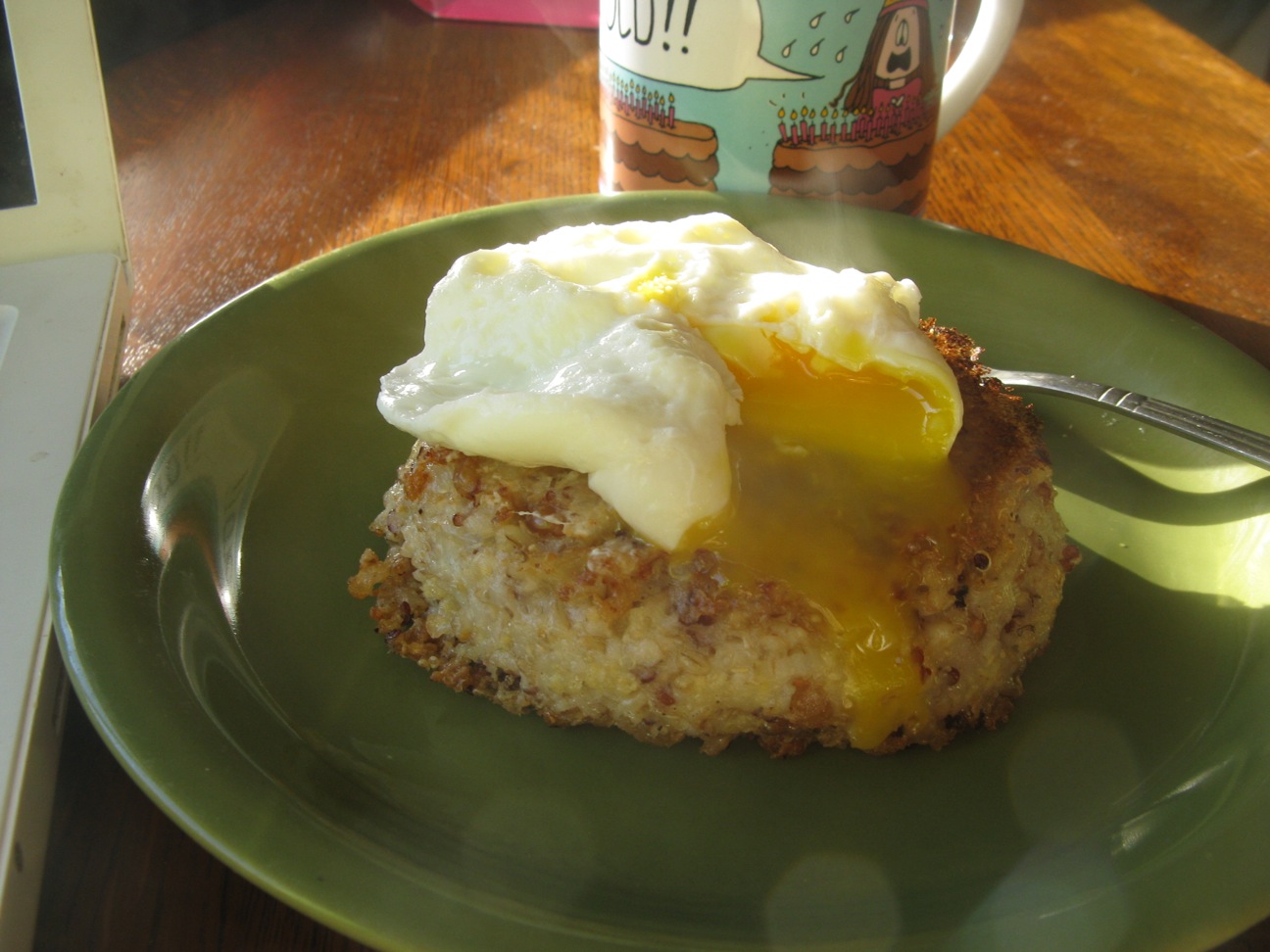
I've been trying to take this picture of fried oatmeal with a poached egg on top for a couple days now and this morning I think that I finally got it:

Awesome, and I have enough leftover oatmeal and eggs to make one for breakfast tomorrow morning. This is one of my favorite breakfasts--kind of a pain to make, but now that it's cold again oatmeal is a welcome addition to any morning.

I also got a pretty great picture of mushroom risotto.


This particular bowl was actually not super delicious because I threw some potatoes, leeks and fennel on top, and all three of these more assertive flavors overwhelmed the delicate flavor of the chanterelles, which I would have discovered had I googled "delicate flavor of chanterelles" before I started cooking.

Still, I think it looks great, and it should prove to be good fodder for my first attempt at arancini tomorrow.

UPDATE:


That is all.